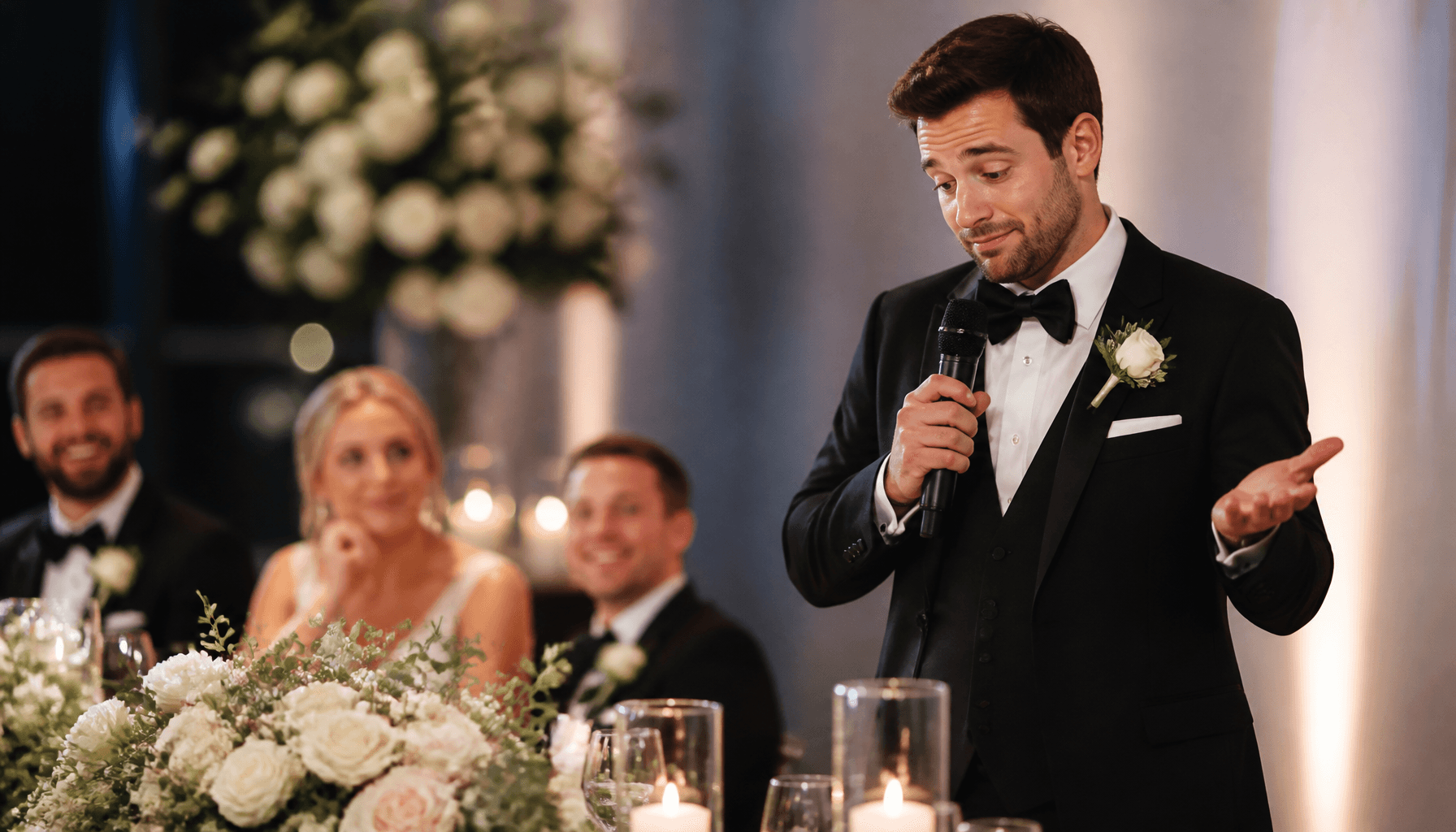
Best Man Speech Nerves: How to Recover When a Joke Gets No Laughs
Best Man Speech Nerves: How to Recover When a Joke Gets No Laughs
You deliver the punchline you practised all week. You pause. Someone adjusts a chair. And suddenly, your best man speech nerves are louder than anything coming through the microphone.
That silence can feel enormous, but one missed joke does not make a bad wedding speech. Guests are there to celebrate the couple, not judge your comedy credentials. What matters is how you handle the next few seconds—and how you make the newlyweds feel.
The best recovery is usually simple: pause, settle yourself, and move forward without making the moment bigger. Here is how to recover when a best man speech joke gets no laughs, plus how to prepare a speech that never depends on punchlines alone.
1. Understand What a Quiet Room Actually Means
When you are nervous, silence can sound like rejection. In reality, a joke might miss because guests did not hear the setup, the reference was too specific, or the catering team arrived at exactly the wrong moment. Some people may simply smile rather than laugh aloud.
Imagine telling a story about the groom’s legendary spreadsheet habit. His colleagues might find it hilarious, while his extended family needs more context. That is an audience mismatch, not proof that you are failing as best man.
Before reacting, remember:
- A wedding audience is mixed. Friends, grandparents, colleagues, and children will not share every reference.
- Warmth counts as a response. Smiles and attentive faces matter, even without a big laugh.
- One moment is not the whole speech. You still have stories, gratitude, and a toast ahead.
Your job is to honour the couple and help guests feel connected to them. Humour is a bonus, not the pass-or-fail test.
2. Use a Simple Recovery Plan When a Joke Falls Flat
Best man speech nerves can tempt you to fill every silence. Resist that urge. Talking faster, repeating the punchline, or explaining why something was funny usually draws more attention to the missed laugh.
Instead, follow this short sequence:
- Pause for a beat. Give the room a moment to respond, but do not keep waiting for laughter.
- Take one comfortable breath. Relax your shoulders and let your next sentence come at your normal speaking pace.
- Keep a relaxed expression. A small, natural smile is enough; you do not need to perform exaggerated embarrassment.
- Move to the next thought. Look at your notes if needed, then continue with the story or a sincere observation.
For example, after a quiet joke about the groom’s overplanning, you could say: “But that thoughtfulness is also one of the things I admire most about him.” Then give a genuine example. The transition works because it connects the humour to something meaningful.
If you need a neutral bridge, try: “What I really want you to know about him is this…” Avoid “Tough crowd” or “You were supposed to laugh.” Those lines turn your discomfort into the audience’s problem.
If the joke was hurtful rather than merely unfunny, handle that differently. Offer a brief, direct apology—“I’m sorry; that was unfair”—and move to respectful material without defending the joke.
3. Build a Best Man Speech That Does Not Depend on Laughs
The strongest protection against a flat joke is a speech with substance. If every sentence is a punchline, a quiet response can knock you off balance. If the humour sits inside a warm story, you always have somewhere to go next.
Use a straightforward structure:
- Introduce yourself. Explain your relationship to the groom briefly.
- Tell one accessible story. Choose something guests can understand without knowing your entire friendship history.
- Explain what it reveals. Connect the story to a quality such as loyalty, generosity, or patience.
- Celebrate the couple. Include the groom’s partner and a sincere observation about their relationship.
- Finish with a clear toast. Invite guests to raise their glasses and wish the newlyweds well.
For wedding speech humour, favour affectionate observations over humiliation. A groom who packs three phone chargers for a weekend away offers safer material than an ex-partner, a private argument, or an embarrassing secret.
Try the “no-laugh test”: read your speech without pausing for any laughs. Does it still feel complete and kind? If a joke adds nothing except an expected reaction, consider cutting it.
If you are stuck turning memories into a coherent draft, ToastPal can help you get a starting point on the page, leaving you more time to personalise and practise.
4. Rehearse the Recovery, Not Just the Punchlines
Practising only your ideal delivery leaves you unprepared for an ordinary wedding room. Rehearse out loud with pauses, background noise, and the possibility that nobody laughs.
Ask one trusted person to listen. Rather than asking only, “Was it funny?”, ask, “Was anything confusing, unkind, or too long?” That feedback is more useful than reassurance alone.
- Mark a transition in your notes. Highlight the sentence that takes you from the funny story to its sincere meaning.
- Use readable prompts. Short paragraphs and large text make it easier to find your place.
- Practise continuing after silence. Deliver a joke, pause briefly, then carry on without commentary.
- Check the microphone beforehand. Ask the venue team how to hold it so your words are clear.
- Avoid relying on alcohol for confidence. You want steady pacing and clear judgement.
Immediately before speaking, plant your feet, release your shoulders, and take a comfortable breath. Aim to speak to the people in front of you, not to recreate a flawless performance.
Conclusion: A Missed Laugh Is Not a Failed Speech
Best man speech nerves do not have to take over when a joke falls flat. Pause, breathe, and move naturally to your next thought. Avoid explaining the punchline or blaming the room, and build your speech around stories that matter even without laughter.
You do not need to be the funniest person at the wedding. You need to be a good friend with something genuine to say. Deliver that with warmth, and one quiet moment can stay exactly that: one moment.