
Best Man Speech Tips: How to Write, Practice, and Deliver the Perfect Toast
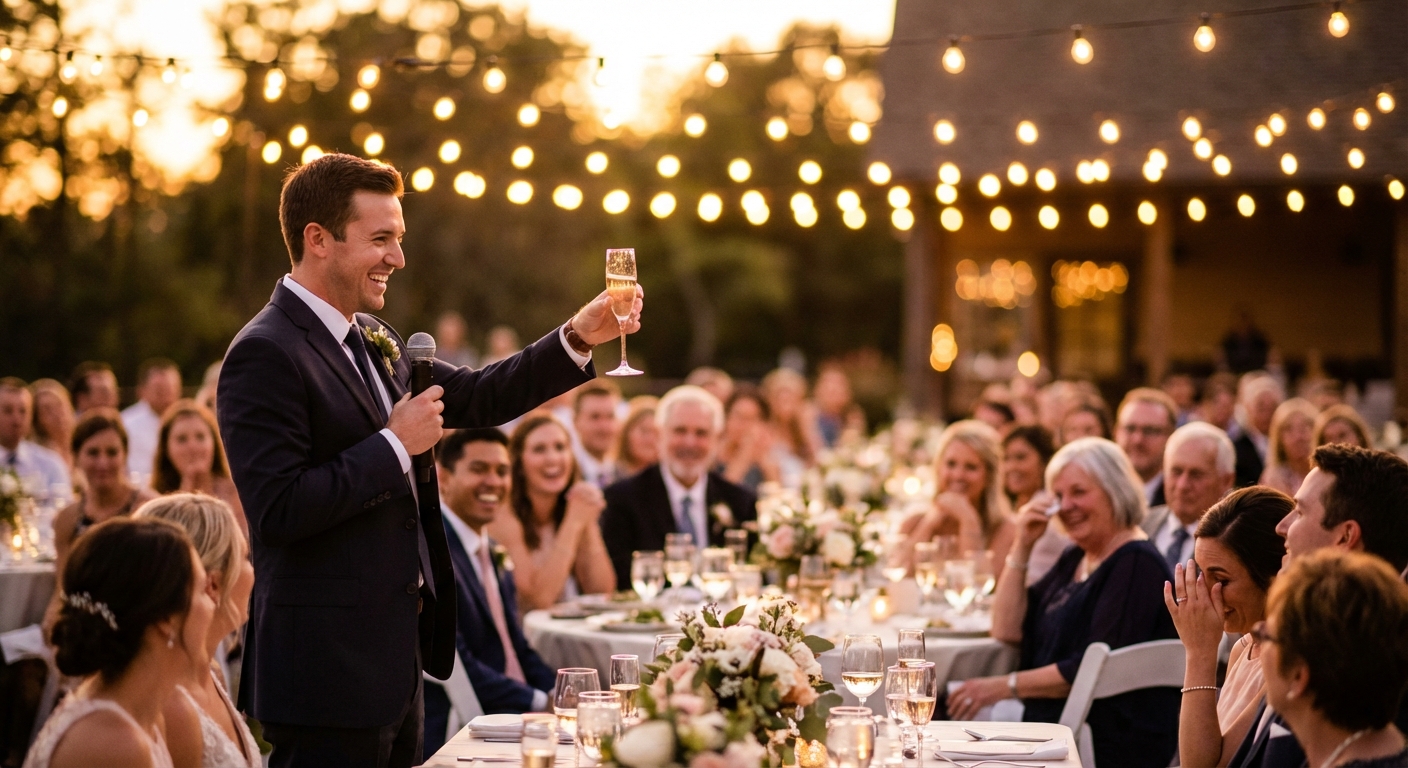
Best Man Speech Tips: Write, Practice, and Deliver the Perfect Toast
You’re honored, a little anxious, and determined to get it right. Whether you’ve got weeks or just a weekend, you can craft a toast that feels true to you and lands beautifully with the room.
This guide gives you practical best man speech tips: a clear structure, opening lines, short examples, a rehearsal checklist, and delivery advice. You’ll also get three ready-to-personalize templates (60 seconds, 3–5 minutes, and a joint version), plus a mic practice script and swipeable toast closers. ToastPal can help you turn your stories into a polished speech quickly with AI-guided prompts, role-specific customization, and easy editing to match your voice.
What Guests Actually Want from a Best Man Speech (Length, Tone, and Vibe)
Your speech isn’t a roast or a one-man show—it’s a kind, concise celebration of the couple with a couple of well-chosen moments about the groom. Wedding publishers align on the basics: keep it short, sincere, and personal. Guidance on how long should a best man speech be from Zola lands around three to five minutes, which matches what guests can comfortably enjoy late in the reception. A helpful overview of best man speech expectations from The Knot underscores what to include (thanks, stories, a toast) and what to skip (exes, crude humor). For a simple framework on how to write the perfect best man speech, Brides provides a classic structure that mirrors what audiences respond to most—a clear arc, one or two vivid anecdotes, and a warm closing.
The Ideal Length (best man speech length)
- Keep it under five minutes; three to five minutes is the sweet spot.
- That’s roughly 600–900 words at a natural pace (about 140–160 wpm).
- Consider the run of show—guests have been on their feet and at the table; shorter is kinder and more memorable.
- If several people are speaking, aim closer to three minutes.
The Right Tone
- Lead with warmth; keep humor kind and inclusive.
- Avoid roasts, inside jokes without context, and stories that could embarrass the couple or families.
- Speak to the whole room: grandparents, kids, coworkers, and friends.
- Compliment the partner directly—this is about both of them.
What Makes a Speech Memorable
- One clear theme about the groom (loyalty, thoughtfulness, quiet humor).
- One or two clean, vivid stories that show that theme.
- A simple, heartfelt toast that brings it back to the couple.
How to Write a Best Man Speech: A Simple, Fail-Safe Structure
If you follow this outline, you won’t ramble. It keeps your thoughts tight and your message heartfelt—especially helpful if you’re busy or nervous.
- Opener + gratitude (20–30 seconds) — Introduce yourself and your connection to the groom. Thank the hosts and acknowledge families. Frame the moment: you’re honored to celebrate the couple.
- Compliment the partner (20 seconds) — Offer a sincere, specific compliment about the bride/partner.
- One core theme about the groom (20–30 seconds) — Choose a single trait (e.g., “he shows up,” “he cares deeply,” “he makes people feel included”).
- One or two short, clean stories (60–120 seconds) — Include a crisp beginning–middle–end and one vivid detail. Keep it family-friendly and focused on the trait in action.
- Why they work together (30–45 seconds) — Share what they bring out in each other with one concrete example.
- Advice or well-wishes (20–30 seconds) — Keep it simple, sincere, and personal to them.
- Toast (10–20 seconds) — Invite guests to raise a glass. Use their names and a warm, clear toast line.
Keep It Tight: Transitions and Signposting
Simple connectors help the room follow your arc. Examples: “For those I haven’t met, I’m [Name], and I’ve known [Groom] since [context].” “That brings me to what I admire most about [Groom]…” “Please raise a glass to [Couple Names]…”
Integrate Personalization Without Oversharing
- Skip exes, adult-only stories, or jokes about heavy drinking.
- Double-check names and pronunciations for families and elders.
- If a story needs too much context, choose a different one.
- When unsure, choose kindness and brevity.
Opening Lines and Story Ideas That Hook the Room
A clean, confident start relaxes the room and settles your nerves. Smile, pause, deliver your opener, then continue.
Strong Opening Lines
- “Good evening! I’m [Name], [Groom]’s best man and the official fact-checker for his tall tales.”
- “I’m [Name]. I’ve known [Groom] for [X years], and tonight I get to celebrate the happiest version of him—standing beside [Partner].”
- “I’m [Name], and my job is simple: say a few true things about a great friend and toast an even greater couple.”
- “When I met [Groom] in [place], two things stood out: he listens, and he shows up.”
- “Every so often, two people make each other more themselves. That’s [Groom] and [Partner].”
- “I promised [Groom] three minutes and no secrets. Good news—I’m keeping at least one of those promises.”
- “I’m [Name]. Thank you to the families—tonight’s celebration feels exactly like [Couple Names]: thoughtful and joyful.”
Story Ideas That Work
- The first time you saw the couple together and noticed how well they fit.
- A moment when the groom stepped up—helping someone, taking responsibility, showing quiet leadership.
- A small, specific story with a big meaning: a late-night rescue, moving day support, planning a surprise for a friend.
Stories to Avoid
- Exes or past relationships.
- Bachelor party details or adult-only humor.
- Legal or work-sensitive topics.
- Divisive subjects (politics, religion).
- Anything that could embarrass the couple or their families.
One-Minute “Micro-Structure” for Short Speeches
When time is tight:
- Intro + gratitude (10–15 seconds)
- One story that shows a trait (30–35 seconds)
- Compliment the partner (10 seconds)
- Toast (5–10 seconds)
Templates and Examples You Can Customize (60s, 3–5 Min, Joint Best Man)
Use these short best man speech examples as starting points. Swap in your details where you see brackets, and keep it clean and kind.
60-Second Version (Approx. 160–180 words)
“Good evening! I’m [Name], [how you met] with [Groom]. Thank you to the families for today—it’s been beautiful. What I admire most about [Groom] is [a positive trait], and I saw it clearly when [story with a clear beginning, middle, and end]. He didn’t make it about himself; he made sure everyone was okay. Then he met [Partner], and the best parts of him got louder—more [quality], more [quality]. [Partner], you bring out [Groom]’s [specific strength], and he lights up around you in a way we’ve all noticed. I won’t keep you long, but I will say this: if you two keep choosing each other with the same kindness and courage you’ve shown so far, the ordinary days will be your favorite ones. Please raise a glass with me to [Couple Names]—to love, laughter, and a lifetime of showing up for each other. Cheers!”
3–5 Minute Version (Approx. 700–850 words)
“Good evening, everyone. I’m [Name], and I’ve had the privilege of knowing [Groom] for [X years] since [context—college, hometown, work]. Thank you to the families for this thoughtful day—it feels exactly like [Couple Names].
I want to start with [Partner]. From the first time we met, you had this calm way of making people feel seen. You ask great questions, you listen, and you laugh with your whole face. As [Groom]’s friend, that meant the world—you welcomed all of us, and you’ve made [Groom] the happiest version of himself I’ve ever seen.
If I had to choose one theme for [Groom], it’s that he shows up. In big moments and small ones, he’s there. Years ago, when [brief setup], I called him late. He didn’t hesitate. He drove over with [specific detail—pizza, tools, a pep talk], and he stayed until [result]. That’s the kind of friend he is: steady, dependable, and quietly hilarious at just the right moment.
There’s a story that captures this. [Tell one short, clean story with a clear arc that illustrates the trait. Include one vivid detail: a phrase he said, an action he took, something he fixed. Keep it kind and brief.] That’s [Groom]. No spotlight, just substance.
And then he met [Partner]. The first time I saw them together, I noticed [specific observation: the way they look at each other, the way they listen]. [Partner] brings out [Groom]’s [strength—patience, generosity, boldness], and [Groom] brings out [Partner]’s [strength—confidence, playfulness, sense of adventure]. Together, they’re balanced in the best way—[a small example of them as a team: planning, supporting family, building traditions].
I’m not big on advice, but I’ll share one thought that feels true watching you both: real love is a daily practice, not a performance. You’ve already shown you can do the small things that matter—checking in after a long day, laughing at the unglamorous moments, and keeping your promises when it’s inconvenient. If you keep doing those things, every year will deepen what you’re starting today.
So to [Couple Names]: may your home be filled with ordinary magic, your adventures be kind to your shoes, and your kitchen always have the right amount of coffee and laughter. Please raise a glass with me to [Groom] and [Partner]—to a life you’ll be proud to look back on together. Cheers.”
Joint Best Man Version (Two Speakers, ~700–800 words)
Speaker 1: “Good evening! I’m [Name], and this is [Name]. We’re honored to be [Groom]’s best men. Thank you to the families for a day that’s joyful and so thoughtfully done.”
Speaker 2: “We made a deal to keep this short and kind, and if we start to go long, the DJ has our permission to cut the mic.”
Speaker 1: “If there’s one trait we both agree on, it’s [core theme—loyalty, generosity, humor with heart].”
Speaker 2: “I saw it when [short, clean story from Speaker 2 with a clear arc]. He didn’t wait to be asked. He just showed up.”
Speaker 1: “Same trait, different moment. [Another short, clean story from Speaker 1—brief and warm.] That’s [Groom] to us.”
Speaker 2: “Then came [Partner]. The first time we saw them together, we had the same thought: they fit.”
Speaker 1: “[Partner], you bring out [Groom]’s [strength], and [Groom], you bring out [Partner]’s [strength]. Together, you’re better in all the ways that matter—[one specific example of teamwork].”
Speaker 2: “We’re not here for a roast; we’re here because we love you both and we’re thrilled to celebrate this.”
Both: “Please raise a glass with us to [Couple Names]—to love that lasts and joy that grows. Cheers!”
Personalization prompts for each template
Replace [how you met], [a positive trait], [story with clear beginning–middle–end], [partner compliment], [why they work together], [wish/toast] with your details.
Copy-friendly closing toast lines (Click to copy)
- “To [Couple Names]—may your love be easy in the hard moments and deeper in the sweet ones.”
- “To [Groom] and [Partner]—to a lifetime of showing up for each other.”
- “To [Couple Names]—may your home be full of laughter and your calendar full of little adventures.”
Cue card (downloadable idea)
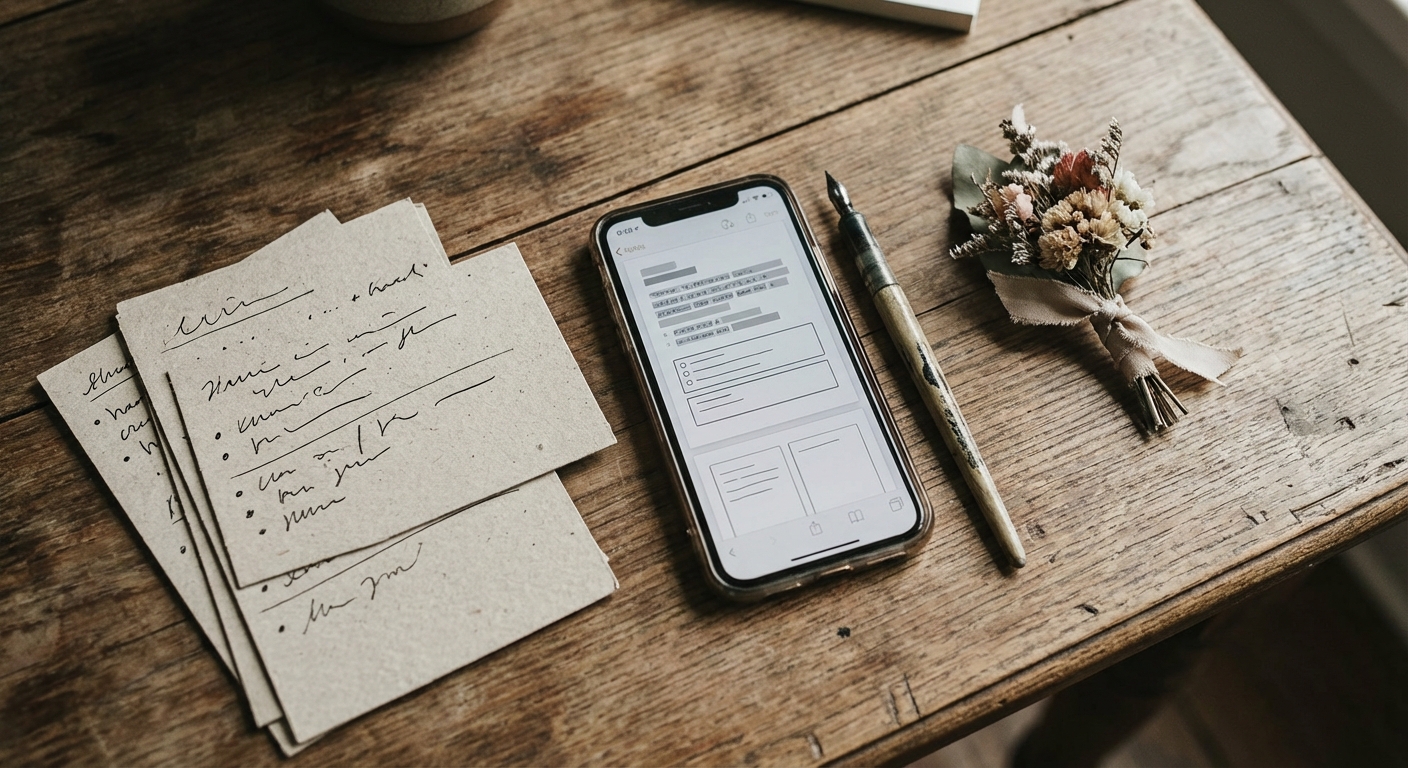
Front: Name + role; big-font toast line; section bullets (Opener/thanks; Partner compliment; Trait; Story; Why they work; Wish; Toast).
Back: Names and pronunciations; pacing note (breathe, pause); mic hand reminder; “Smile.”
Note: ToastPal also supports other roles with the same AI personalization—Maid of Honor, Father/Mother of the Bride or Groom, vows, general wedding speeches, and eulogies—so everyone can feel prepared and confident.
Delivery and Rehearsal: Practice Plan, Mic Technique, and Confidence Tips
You don’t need performance skills to deliver a great toast. A little prep goes a long way.
Rehearsal Checklist
- Time yourself; aim for under five minutes.
- Print large-font cue cards; bold the final toast line.
- Practice transitions and signposting.
- Record a run-through (voice memo or quick video) to check pacing and clarity.
- Rehearse with a friend and ask for one suggestion to tighten.
- Decide mic hand; practice raising your glass smoothly.
- Confirm where you’ll stand; find a comfortable sightline to the couple.
- Coordinate with the DJ/MC on timing and music cues.
- Keep a backup note on your phone—but avoid reading from it start to finish.
- Dress rehearsal: check pockets for cards, jacket comfort, and shoe stability.
- Hydrate, and pace alcohol until after you speak.
Mic Technique: 30-Second Practice Script
Hold the mic 1–2 inches from your lips and speak across it, not straight into it. Relax your shoulders, smile, and aim for a conversational pace. Try this two-sentence script to test volume and clarity: “Good evening, everyone. I’m [Name], and I’m honored to celebrate [Couple Names] tonight.” Pause to confirm you can be heard across the room, then add: “Thanks for being here for two extraordinary people—let’s make them feel the love.”
Managing Nerves
- Box breathing: inhale 4, hold 4, exhale 4, hold 4—repeat four times.
- Grounding: feel your feet in your shoes; soften your knees; unclench your jaw.
- Visualize the first 30 seconds going smoothly; that’s often enough to settle.
- Memorize your opener and final toast; keep the middle on cue cards.
- Keep water nearby; take a small sip before you begin.
Accessibility and Inclusivity
- Speak clearly and avoid niche slang; provide context for quick jokes.
- Consider multilingual or intergenerational audiences; keep humor universal.
- Enunciate names; be mindful of cultural or religious traditions the couple values.
Humor vs. Heart: Getting the Tone Right (Dos & Don’ts)
Dos
- Do keep jokes kind, quick, and relatable.
- Do include at least one heartfelt line about the couple’s character.
- Do thank the hosts and acknowledge families with one sincere sentence.
- Do compliment the partner specifically.
- Do choose one clear theme and anchor your story to it.
Don’ts
- Don’t roast or embarrass the couple.
- Don’t mention exes, bachelor party details, or adult-only stories.
- Don’t wing it; even 15 minutes of prep improves everything.
- Don’t read your entire speech from your phone.
- Don’t monopolize the mic; be mindful of other speakers and the timeline.
Cultural and Family Sensitivity
- Keep the room’s mix in mind—elders, kids, and diverse backgrounds.
- Avoid off-color humor; err on the side of warmth and respect.
- If you’re unsure about a line, run it by the couple in advance.
Common Mistakes to Avoid + Quick Checklist + CTA
Frequent pitfalls:
- Running long or trying to cover every childhood memory.
- All jokes, no heart—or all sentiment, no levity.
- Forgetting to mention the partner.
- Inside jokes without context that leave the room behind.
- Obscure references, complicated quotes, or private details.
- Speaking intoxicated or before you’re grounded.
- Crumpled paper, tiny font, or no clear toast at the end.
- Last-minute writing that leads to rambling.
Quick pre-speech checklist
- Length under five minutes (600–900 words).
- One clear theme; one or two stories max.
- Compliment the partner; thank the hosts/families.
- Printed cue cards in large font; toast line bolded.
- Mic checked; glass ready; names and pronunciations confirmed.
If you’re short on time or stuck at the starting line, the ToastPal tool helps you build a polished draft in minutes—personalized to your stories, tone, and timing. For extra confidence, browse reviews from real users who turned nerves into applause, and keep sharpening your approach with other helpful blog posts on delivery, humor, and role-specific guidance. See testimonials for real examples of speeches that worked.
FAQs
How long should a best man speech be?
Three to five minutes—about 600–900 words—keeps it heartfelt and focused without losing the room.
What is the best structure for a best man speech?
Intro and thanks; compliment the partner; one core theme about the groom; one or two clean stories; why they work together; brief wishes; toast.
What are great opening lines for a best man speech?
Short and warm lines work best, such as “For those I haven’t met, I’m [Name], and I’m honored to celebrate [Couple Names]—I’ll keep this brief and true.”
How many jokes should a best man speech have?
One or two kind, quick moments of humor are enough; let heart lead and humor support.
What are common mistakes in a best man speech?
Too long, inside jokes without context, adult-only stories, forgetting the partner, no clear toast, or reading from a phone the entire time.
Can two best men give a joint speech? How do we split it?
Yes. Alternate sections: intro and thanks (Speaker 1), first story (Speaker 2), second story (Speaker 1), couple compliment (Speaker 2), joint toast.
What should I avoid saying in a best man speech?
Exes, bachelor party details, crude humor, divisive topics, and anything the couple wouldn’t want grandparents to hear.
How far in advance should I start preparing?
Two to three weeks is comfortable; even 48 hours can work with a focused outline and a quick practice plan.
What if I’m nervous and hate public speaking?
Memorize the opener and final toast, rehearse transitions, try box breathing, and keep cue cards handy as a safety net.
Can ToastPal help me write an original best man speech quickly?
Yes. AI-guided prompts tailor your draft to your stories, role, and tone so you can produce a polished speech fast.
How do I adapt my speech if the wedding is non-traditional?
Keep the same structure and adjust acknowledgments, tone, and any references to match the couple’s style and customs.
Is it okay to read from note cards or a phone?
Note cards are great—clean and large-font. Avoid reading from your phone for the whole speech; use it only as a discreet backup.