How to Write a Best Man Speech: Roast, Toast & Boast (Template + Examples)

How to Write a Best Man Speech: Roast, Toast & Boast (Template + Examples)
So, your best friend just asked you to be his best man. Congratulations are in order. You have been given the honor, the photos, the bachelor party planning duties, and then the moment that quietly terrifies most people: standing up, holding a microphone, and saying something meaningful in front of a room full of people who love the couple. Writing a wedding speech doesn't have to be a source of stress.
If your brain is currently bouncing between wanting this to be perfect and worrying that you might blank out and say something weird, you are normal. Truly. Public speaking consistently ranks as one of humanity’s top fears. You do not need to be a stand-up comedian or a dramatic orator to succeed here. You simply need to be you, showing up for your friend, with a few laughs, a few heartfelt lines, and a clean finish that gets everyone cheering.
That is exactly what the Roast, Toast, and Boast method gives you. It is a simple three-part structure that keeps you funny without being risky, sincere without getting mushy, and short enough that the kitchen staff doesn’t start clearing plates mid-sentence.
If you are staring at a blank page right now, you are not alone. A lot of best men can talk about the groom for hours at a bar but freeze when it is time to write. This guide will walk you through the mechanics of a great speech, from the psychological framework to delivery hacks. However, if you find yourself needing extra help, the ToastPal Best Man Speech generator can turn your real memories into a polished draft in minutes, using guided prompts to capture your voice and your relationship in a way that feels personal.
Why the Roast/Toast/Boast Method Works
When people ask how to write best man speech content that lands well, they are usually fighting two problems at once. First, they do not know what to include. Second, they do not know how to order it. The Roast, Toast, and Boast method fixes both by giving your speech a clean emotional arc that takes the audience on a journey.
The structure works because it mirrors the way we naturally connect with stories. You begin with the Roast, which provides laughter and warmth. This breaks the tension in the room and, perhaps more importantly, relaxes you. It signals to the audience that they can relax because you are not going to make this awkward. It helps you settle into your voice before you say anything emotional.
Next, you move into the Boast. This is where the speech earns its place in the wedding day. You pivot from humor to meaning and sincerity. You honor the groom and the couple. As experts at Toastmasters note, speaking from the heart is the key to a great toast, and this structure ensures you get to that heart quickly without feeling like you slammed the brakes from joke to tears.
Finally, you Toast. This provides celebration and closure. The best speeches end decisively. No wandering. No awkward trailing off. A toast gives you a natural finish line, and it invites the whole room to participate in the celebration.
Quick Checklist Before You Start
Before you write a single line, set yourself up for success. Understanding the context of your speech is the difference between something that sounds "pretty good" and something that feels perfect for the couple.
Know Your Audience
Most wedding crowds are multigenerational and mixed company. You will have grandparents, coworkers, childhood friends, the couple’s university roommates, and someone’s plus-one who has never met anyone. You are speaking to all of them.
A good rule is to keep it friendly enough that it would still feel appropriate at a family dinner. You can be cheeky, but stay kind. Your job is to make the groom look loved, not exposed. If the couple’s families are more traditional, keep language cleaner and jokes gentler. If the crowd is very diverse culturally, avoid slang-heavy references or niche inside jokes that exclude most people.
Time It Right
One of the most common questions is about length. Most wedding experts, including The Knot, suggest you aim for 3–5 minutes; shorter is often better to keep engagement high. That is roughly 450 to 750 words depending on your pacing.
If you are choosing between cutting a story and keeping it, cut it. Leave them wanting one more line, not begging for the finish. A tight, well-crafted 3-minute speech will always outperform a rambling 7-minute one.
Gather Material with the Right Questions
You do not need the funniest story ever told. You need two or three moments that show who the groom is, why you respect him, and why this match makes sense. To mine your memory for the best content, ask yourself these specific questions:
- When did I meet the groom, and what was my first impression?
- What is one harmless, lovable quirk he has?
- When has he shown up for me in a real way?
- What did I notice change in him after he met his partner?
- What is a small moment that sums up their relationship?
- What do I genuinely hope their life looks like in 10 years?
Write down your answers without editing them. You will refine them later, but right now you are looking for raw material.
Pick Your Theme
Themes keep speeches cohesive. Choose one that feels true to your friendship. Perhaps he has always been the most loyal person you know. Maybe he acts confident but is secretly the most thoughtful guy in the room. Or perhaps he is the fun one who is also the steady one when it counts. Your stories and compliments should support that theme. It makes the speech feel intentional, not like a list of random memories.
The Roast: Dos, Don’ts, and Safety Checklists
Let’s make the word "roast" safe again. In the context of a wedding, a roast is affectionate teasing. It should feel like you are gently tapping the groom on the shoulder, not throwing him under a bus. A good wedding roast gets a laugh without making anyone cringe, humanizes the groom, and sets up your sincerity later.
The Roast-Safety Checklist: What NOT to Say
If you remember nothing else, remember this: if it would stress the couple out tomorrow, do not say it today. There are absolute forbidden zones you must avoid.
Exes and Past Relationships: This is the nuclear option of bad speech content. Mentioning the groom’s previous partners, comparing them to his current partner, or making jokes about his dating history is a guaranteed way to create discomfort. If your story involves an ex, it does not belong in this speech.
Money and Financial Issues: Jokes about the groom being broke, in debt, or cheap might seem harmless to you, but they can trigger real anxiety. Weddings are expensive and life is stressful. Keep money out of it entirely.
Sex or Intimacy: Keep it PG-13 max. The couple’s parents and grandparents are right there. Innuendo that is subtle enough to fly over kids’ heads is fine, but graphic details are not.
Humiliating Secrets: If the groom begged you not to tell it, you already know the answer. If police were involved, if someone could have gotten seriously hurt, or if the story reveals genuinely bad judgment, leave it out.
Insults Targeting Identity: Weight, appearance, disability, mental health, race, religion, gender, or sexuality are off-limits. A simple test is to ask yourself if the groom’s partner would feel protective hearing it. If the answer is yes, skip it.
Safe Joke Openers
If you are struggling to find safe roast material, focus on harmless quirks. Here are a few openers you can adapt:
- "For those who don’t know me, I’m Tom. I’ve been stealing the groom’s hoodies since 2008. Tonight I got my hoodie back: his fiancé actually made him wear a proper jacket."
- "I’ve known the groom a long time, and I can honestly say he’s always had two great talents: being a loyal friend, and somehow surviving on pizza like it’s a balanced diet."
- "When he asked me to be best man, I was honored. Then I remembered it involves public speaking, so I’ve been practicing in the mirror, and my mirror has requested a restraining order."
- "They say marriage is about compromise. Which is great, because the groom has been practicing compromise his whole life by letting the rest of us pretend his dance moves are normal."
Notice what these do. They tease lightly, then they set you up to say something real.
Balancing Humor with Sincerity
It is tempting to think that the funniest speech wins. But weddings reward warmth. As Brides.com advises, a few jokes can break the ice—don’t make them the meat of the speech. The roast is just the appetizer.
A practical ratio for most best men is about 20 to 30 percent jokes, and 70 to 80 percent warmth, story, and praise. If you are naturally funny, keep it anyway. If you are not naturally funny, do even less. One solid smile is better than five risky lines that fall flat.
The Boast: How to Make It Genuine
If the roast is the fun part, the boast is the part people remember. This is where you answer the quiet question in the room: "Why does this friendship matter, and why does this marriage make sense?"
The Pivot
You need a smooth transition from the jokes to the meaning. A simple phrase works best. Try saying, "But honestly," or "In all seriousness," or "Jokes aside for a second." Then, slow down your speaking pace slightly. The shift in pace signals sincerity to the audience.
Boasting About the Groom
The secret to praising the groom without sounding cheesy is specificity. Saying "he is an amazing guy" is nice, but it is forgettable. Saying "he drove three hours at midnight because I needed him" is memorable. Use a format of Trait plus Proof plus Emotional Meaning.
For example: "He is loyal. When my dad was sick, he checked in every day, no big speeches, just showing up. That is who he is." Or: "He is calm under pressure. Even when things go wrong, he is the guy who makes the next right move."
Boasting About the Partner
A best man speech that ignores the partner feels incomplete. The couple is the point of the day. You do not need to pretend you have known the partner forever. You just need to be generous and real.
Talk about how the partner has changed the groom for the better. "From the moment she came into his life, I noticed he started standing a little taller." Or: "You bring out a kindness in him that is a gift to everyone who loves him."
If you are struggling to find the right words for these emotional sections, looking at examples of Vows can sometimes help inspire the right tone of deep affection and promise, even if you are writing a speech rather than vows.
The Toast: How to Close & Raise a Glass
The toast is the moment you hand the room a clear action. People love clarity at weddings. This is not another paragraph of stories. It is the finish line.
The Call to Action
Explicitly instruct the audience. Say, "Please raise your glasses to the happy couple." If you are able, ask them to stand. Keep it simple and confident.
One-Line Toast Samples
- "To love, laughter, and a home full of peace."
- "To a lifetime of being on the same team, even when you disagree about the thermostat."
- "To the two of you, may the best days still be ahead."
- "To a marriage full of patience, joy, and really good snacks."
Templates & Outlines (30s to 5 Minutes)
Use these templates like a framework. You are not memorizing a script; you are filling a structure that keeps you safe, sharp, and sincere.
The 30-Second "Short & Punchy" Template
Use this if you are one of multiple speakers or if the couple has requested brief remarks.
- Intro (5 seconds): "Hi, I’m [Name], the best man."
- Roast (10 seconds): "I’ve known [Groom] since [when], which means I know [one lovable quirk] and that he somehow always lands on his feet."
- Boast (10 seconds): "But truly, seeing him with [Partner] has made him the best version of himself."
- Toast (5 seconds): "Please raise a glass. To love, laughter, and a lifetime of taking care of each other. Cheers."
The 90-Second "Sweet Spot" Template
This is the ideal length if you want to make an impact without overstaying your welcome.
- Intro (10 seconds): "Hi everyone, I’m [Name]. For those who don’t know me, I’m [relationship]."
- Light Roast (20 seconds): "I’ve been around long enough to say with confidence that [Groom] is [light tease], and somehow he’s still one of the most lovable people I know."
- Boast (45 seconds): "One thing I really admire about him is [quality]. I’ve seen it in moments like [short story]. And since meeting [Partner], he’s [positive change]. [Partner], thank you for loving him so well."
- Toast (15 seconds): "So here’s to the happy couple. May your life be full of the good stuff: teamwork, patience, and a ridiculous amount of laughter. Cheers."
The 3-Minute "Classic" Template (Optimal)
This is the standard best man speech length, long enough to tell a full story but short enough to keep attention.
- Roast (30 seconds): Open with a joke or funny observation about his habits or your history.
- Story 1 (60 seconds): A funny anecdote that transitions into revealing his character. "I’ll never forget the time [story]. It’s funny now, but it also shows [trait]."
- Transition (10 seconds): "But in all seriousness..."
- Deep Boast (60 seconds): "That’s the version of him I’ve always known. Then [Partner] came along, and it was like someone turned the lights on. He [specific change]. Together you make sense because [shared values]."
- Toast (20 seconds): Closing sentiment and call to raise glasses.
The 5-Minute "Storyteller" Template
Only use this length if you are a confident speaker and the couple has given you the green light.
- Roast Opener (45 seconds): Introduce yourself, deliver 1-2 safe jokes, and set the theme.
- Story Arc (3 minutes): Tell a narrative. Story 1: A funny moment from earlier years. Story 2: A turning point that shows maturity or loyalty. Story 3: The moment you realized the partner was "the one."
- Boast (60 seconds): Praise the groom and partner with specifics.
- Toast (30 seconds): Clear call to raise glasses and a crisp closer.
If you are just a guest rather than the best man and need guidance on a different type of speech, a General Wedding Speech template might be more appropriate for your specific role.
Delivery & Rehearsal Hacks
A great speech on paper can fall flat if it is rushed, mumbled, or delivered like you are apologizing for existing. The good news is that delivery is trainable, even if you hate public speaking.

Managing Nerves for Your Best Man Speech
Let’s address the elephant in the room: you are probably nervous. That is not just normal, it is nearly universal. Many reputable mental-health and communication sources estimate ~70–77% experience some fear of public speaking, a phenomenon known as glossophobia. You are in extremely good company.
To manage this, focus on service, not performance. Your job isn't to be the funniest person in the room; your job is to honor your friend. When you focus on serving them, the anxiety often diminishes.
The Delivery Cheatsheet
Breathing: Use the 4-7-8 technique. Inhale for 4 counts, hold for 7, exhale for 8. Do this twice before you stand up. It physically forces your nervous system to calm down.
Pacing: Slow down. Then slow down again. When you are nervous, your brain speeds up. Consciously pause between sentences. Let laughs fully happen before you continue.
Eye Contact: Look at people, not your notes. If direct eye contact feels too intense, try the "forehead trick." Look at people’s foreheads instead of their eyes. From their perspective, it looks like eye contact, but it feels less intimidating for you.
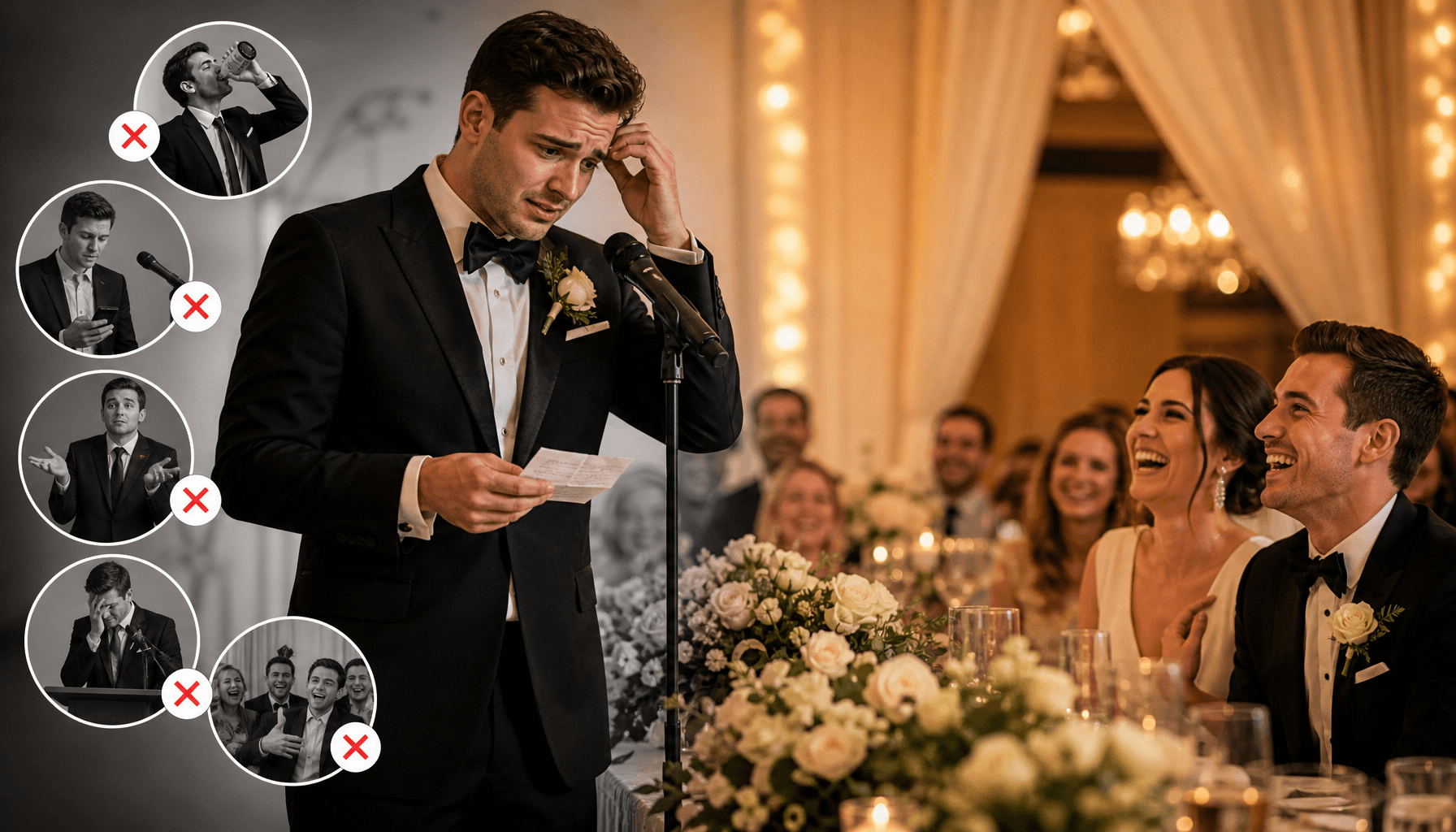
Notes: Use paper note cards, not your phone. Phones make you look like you are texting or distracted. Paper looks prepared. Write in a large font so you can glance down easily.
Rehearsal Tips
You do not need hours of rehearsal. You need smart repetition. Record yourself using your phone. Watching it back is uncomfortable, but it is the fastest way to catch if you are speaking too fast or swaying. Practice the "cold open" by saying your first two lines five times until they are automatic. If you can start strong, the rest will flow.
Still Stuck? Let ToastPal Write It For You
The Roast, Toast, and Boast method is simple, but writing it can still feel hard when you are busy, nervous, or worried about getting the tone right. That is where ToastPal becomes your unfair advantage.
ToastPal helps you turn real memories into a best man speech that sounds like you. It offers true personalization by pulling from your specific answers and relationship details, so it never feels generic. It offers ease of use by guiding you with prompts so you never wonder what to say next. And it offers time efficiency, taking you from a blank page to a polished draft in minutes.
If you want a speech that is funny, sincere, and safe for a multigenerational room, start with the structure above. But if you want the heavy lifting done for you, let ToastPal handle the wording, flow, and pacing. You will spend less time staring at a blank document and more time actually enjoying the wedding.
Full Sample Speeches
Q: How long should a best man speech be?
A: The ideal length for a best man speech is 3 to 5 minutes. This gives you enough time to tell a meaningful story and share heartfelt sentiments without losing the audience's attention. If you are one of multiple speakers, aim for the shorter end (2 to 3 minutes).
Q: What is the order of speeches at a wedding?
A: The traditional order is: Father of the Bride, Groom, Best Man, and Maid of Honor. However, this can vary depending on cultural traditions and the couple's preferences. Check with the couple or wedding planner to confirm the schedule.
Q: Can I read my speech from a paper?
A: Yes, absolutely. Reading from note cards or a printed speech is preferable to trying to memorize everything and risking a mental blank. It shows you prepared. Just make sure to look up and make eye contact frequently.
Q: How do I roast the groom without offending the bride?
A: Focus on harmless quirks, habits, or personality traits that everyone can laugh at. Avoid jokes about past relationships, dating history, or character flaws. The safest roasts highlight endearing flaws like being terrible at cooking or having questionable fashion sense.
Q: What if I get emotional and cry during my speech?
A: Getting emotional is completely okay and often makes the speech more authentic. If you feel tears coming, take a deep breath, pause for a moment, and let yourself feel it. The audience will appreciate the sincerity.
Q: Should I include inside jokes in my speech?
A: Inside jokes can work if you explain them quickly so the whole audience understands. If you reference something only you and the groom know, follow it immediately with a brief explanation. Avoid jokes that make the rest of the room feel excluded.
Q: What if I forget part of my speech while I'm speaking?
A: Don't panic. Pause, glance at your notes, and pick up where you left off. The audience won't notice a brief pause as much as you think they will. If you completely lose your place, it is okay to acknowledge it with humor and then continue.
Q: Is it okay to have a drink before giving my speech?
A: One drink to take the edge off is fine, but avoid drinking too much. Alcohol can impair your judgment, slow your speech, and make you more likely to go off-script. Save the real celebration for after your speech is done.