
Mother of the Bride Speech: 12 Examples, Templates & How to Deliver Yours
Mother of the Bride Speech: 12 Examples, Templates & How to Deliver Yours
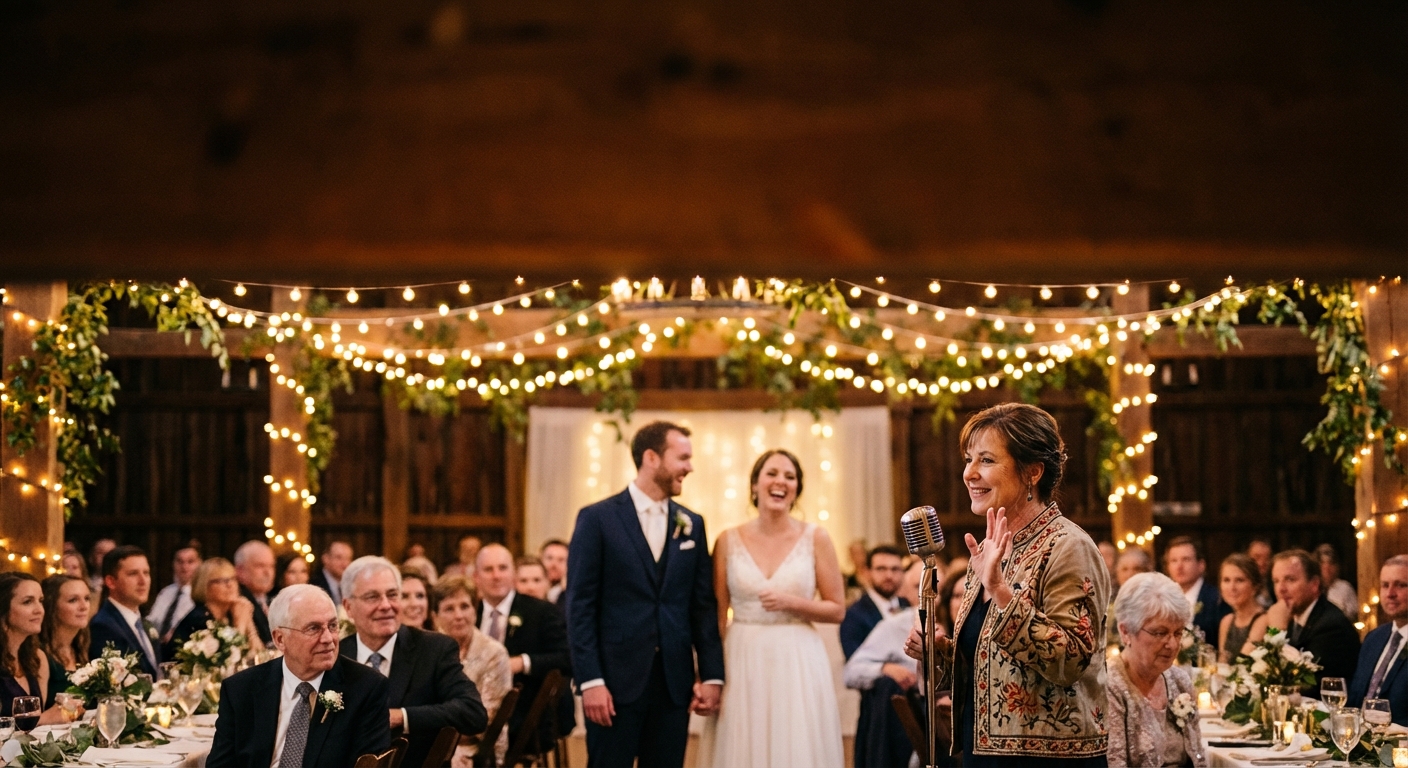 The moment you’ve pictured is here—and yes, a few butterflies are normal. If you’re preparing a mother of the bride speech, this guide gives you everything you need to feel calm and ready: editable templates by length, 12 examples across tones, inclusive wording, and practical delivery tips. You can also generate a personalised AI draft in minutes with ToastPal to save time and build confidence.
What a Mother of the Bride Speech Is (and How Long It Should Be)
A mother of the bride speech welcomes guests, shares one meaningful story, acknowledges your new son- or daughter-in-law and their family, and offers a warm wish for the couple. Think “heartfelt and focused,” not a full biography. The sweet spot is 3–5 minutes, which keeps the room engaged and leaves space for other toasts. If timing runs tight, a short mother of the bride toast can land beautifully at 30–90 seconds (around 60–200 words). For order and timing norms, many couples follow common wedding speech order and length guidance from resources like WeddingWire, which helps planners coordinate the flow of the evening. Placement can vary: many receptions schedule toasts after dinner or between courses, but cultural traditions, brunch receptions, or outdoor celebrations may shift the timing. Keep it flexible and confirm with the couple.
How to Structure Your Mother of the Bride Speech (Simple 5-Part Outline)
A clear structure turns nerves into momentum. Use this path to shape a mother of the bride speech you’ll feel proud to give.
1) Warm welcome and thanks
- Start by greeting guests and thanking everyone who helped make the day possible.
- Use inclusive language to honour blended families, stepparents, grandparents, guardians, and chosen family.
Inclusive phrasing ideas:
- “To everyone who loves [Bride] and [Partner], thank you for being here.”
- “A special thank you to the families and caregivers who shaped them—parents, stepparents, grandparents, mentors, and friends who feel like family.”
- “We’re grateful for the traditions each of our families brings to this day.”
2) A short story or memory
Pick one vivid moment that reflects your daughter’s character. Keep it kind, specific, and relatable.
- Choose a snapshot: a small act of kindness, a determined moment, or the first time you noticed the couple’s steady teamwork.
- Make it sensory and specific: “the paint on her hands,” “the early morning ride,” “the way they looked at each other when the room grew quiet.”
3) Acknowledgment of partner and their family
Welcome your new in-law with genuine warmth and recognise their family with grace.
Neutral, respectful wording:
- “From the first day we met you, [Partner], you felt like home.”
- “To [Partner’s family], thank you for your kindness and the way you’ve welcomed us. We’re so happy our families are now woven together.”
4) Wishes for the couple
Offer hopes or blessings that align with the couple’s values—secular or spiritual, brief and sincere.
- Neutral: “May you keep choosing each other through every chapter—ordinary days and big adventures.”
- Spiritual: “May your marriage be blessed with patience, laughter, and steadfast love.”
- Cultural nod: “May you find joy in small rituals—sharing tea, honouring holidays, and creating traditions that bring your families close.”
5) Toast and closing line
End clearly so guests know to raise a glass.
Sample closers:
- “To love that listens and a home that feels like peace.”
- “To [Bride] and [Partner]—may your love be brave in the storms and tender in the calm.”
- “To the newlyweds—may you choose each other, every day.”
- “Here’s to family, friendship, and a future you’ll build hand in hand.”
- “Please raise a glass with me—to a lifetime of shared laughter and steady love.”
Suggested opening lines (choose 1–2 and make them yours):
- “I’ve loved [Bride] from her first steps to this beautiful new chapter.”
- “When [Bride] was five she insisted on wearing her superhero cape everywhere — today she wears a different kind of cape of love and partnership.”
- “I promised myself I’d keep this short — I’ve always been terrible at promises, but I’ll try, because tonight is about them.”
- “I promised I’d keep this short. As her mother, I love a story—but tonight, I love a timer.”
- “I’ve given many pep talks. Tonight, I come with tissues, not instructions.”
- “Good evening. I’m [Name], [Bride]’s mother, and it’s my joy to welcome you.”
- “To everyone who helped raise [Bride] and [Partner], your love is in this room.”
- “We honour the traditions that shaped us—and the new ones we’ll create together.”
- “Thank you for being here to celebrate the love we’re blessed to witness.”
Personalisation prompts:
- One shared value the couple embodies (kindness, curiosity, service).
- A turning point in your relationship with your daughter (a moment of new understanding).
- A strength you admire in your new son- or daughter-in-law.
- A micro-moment that shows their love (a look, a routine, a supportive action).
- A wish for their future framed as a specific scene (Sunday breakfasts, road trips, long walks, community service days).
Editable Mother of the Bride Speech Templates (Short, Medium, Long) + Downloadable Cheat-Sheet
Short on time? Start with these editable templates, then add a story and a few details to make them yours. If you’d like a polished draft instantly, ToastPal’s AI can personalise tone, cultural touches, and timing in minutes.
Short template (30–90 seconds; ~60–200 words)
“Good evening, I’m [Name], [Bride]’s mother. To everyone who loves [Bride] and [Partner], thank you for being here. To [Partner’s family], we’re delighted to join our families.
When I think of [Bride], I picture [one vivid memory—10–20 words], and how she’s always been [two traits]. Then she met [Partner], and I saw those qualities grow—more [trait], more [trait], and a love that looks like teamwork.
[Partner], we’re grateful for the way you [one thing you admire]. My wish for you both is simple: may you meet life hand in hand, with laughter in your home and courage in your hearts. To [Bride] and [Partner]—cheers.”
Medium template (2–3 minutes; ~300–450 words)
“Hello everyone, I’m [Name], proud mother of [Bride]. Thank you for surrounding [Bride] and [Partner] with so much love. To [Partner’s family], your warmth has been a gift, and we’re thrilled to be one family.
If I had to choose one snapshot that captures [Bride], it would be [specific memory—set the scene briefly]. That moment was so her—[two or three traits: thoughtful, determined, gently hilarious]. Years later, when she brought [Partner] home, I noticed [a micro-moment—how they listened, a small kindness, a laugh they shared]. It felt like watching two steady lights find each other.
[Partner], I admire your [one strength] and how you [specific supportive action]. You bring out [Bride]’s [trait], and together you make the world around you kinder.
My wish for your marriage is that it feels like a safe harbour—calm when life is busy, strong when life is hard, and joyful in the ordinary days. May your home be full of the sounds that mean comfort to you: music in the kitchen, friends around the table, and the quiet of knowing you’re on the same team.
To [Bride] and [Partner]: thank you for letting us witness your love. May you grow in patience, protect your laughter, and keep choosing each other—again and again. With full hearts, we raise a glass to your forever. Cheers.”
Long template (4–5 minutes; ~500–750 words)
“Good evening, I’m [Name], [Bride]’s mother. To our cherished guests—family, friends, and those who’ve travelled far—thank you for celebrating [Bride] and [Partner]. To [Partner’s family], we are grateful for your welcome and the love you’ve shown our daughter.
There are countless stories I could share about [Bride], but one memory lives closest to my heart. [Tell one vivid anecdote from childhood or adulthood—set the scene in 3–5 sentences; highlight a value like perseverance, kindness, curiosity, or courage.] That day, I understood something essential about her: she meets the world with [two traits], and she brings that spirit to everything she does.
When [Bride] met [Partner], I saw that same light reflect back, steady and sure. The first time I knew this was different was [a micro-moment—how they cared for each other during a small challenge, how they welcomed family, a gentle gesture at a busy gathering]. I remember thinking, ‘This is what partnership looks like.’
[Partner], we love the way you [specific supportive action]. You honour [Bride] as she is and cheer her on as she grows. To your family, thank you for raising someone who meets life with [trait].
My wish is not just for grand adventures—though I hope you have many—but for the grace of ordinary days done with love. May you be quick to forgive, generous with your laughter, and protective of your time together. May your home be a place where everyone feels seen and safe. And may you keep finding each other in the midst of busy seasons, with a quiet cup of tea or a shared walk at sunset.
So, to [Bride] and [Partner]: may your love be kind in the small things and brave in the big ones. Please raise a glass with me—to a lifetime of choosing one another. Cheers.”
How to personalise these templates
- Names and roles: Insert your name, the couple’s names, and how families are joining.
- One story: Pick a snapshot that reveals a value; keep it to 2–5 sentences.
- One trait each: Name a strength you admire in your daughter and in her partner.
- One shared hope: Frame a wish as a scene—Sunday breakfasts, hikes, community events, quiet reading nights.
- One toast line: Choose a clear 1–2 sentence close from the sample lines above.
12 Example Mother of the Bride Speeches for Every Tone
These short-form examples show different styles you can use as-is or blend into the templates above. Each follows a clear shape: welcome, one moment, acknowledgment, wish, toast.
1) Short and sweet (30–60 seconds)
“Good evening, I’m [Name], [Bride]’s mother. Thank you for filling this room with love. When I think of [Bride], I picture [one small memory] and how she’s always been [two traits]. [Partner], you bring out the best in her, and we’re grateful to have you in our family. May your days be gentle and your laughter loud. To [Bride] and [Partner]—cheers.”
2) Heartfelt and warm (2–3 minutes)
“Hello everyone. From her first steps to today, [Bride] has been my greatest teacher—curious, brave, and kind. When she met [Partner], I saw a steady, joyful calm settle in. [Partner], your [trait] and the way you [specific action] showed us this was love built to last. May your marriage be a safe harbour, full of ordinary magic. To the newlyweds.”
3) Lightly funny (tasteful, not embarrassing)
“I promised [Bride] I’d keep this under five minutes and save the long stories for the car ride home. I’m [Name], her mother, and my heart could burst. [Partner], you fit our family like you’ve always been here. May your coffee be hot, your Wi‑Fi strong, and your love even stronger. To [Bride] and [Partner]—cheers.”
 4) Formal and traditional
“Good evening. I’m [Name], mother of the bride. On behalf of our families, thank you for honouring [Bride] and [Partner] with your presence. [Short memory]. To [Partner’s family], we are grateful to join with you. May their marriage be rooted in patience, respect, and joy. Please raise your glasses.”
5) Modern and minimalist
“I’m [Name], [Bride]’s mother. Thank you for being here. [One-line story]. [Partner], you make her feel seen. My wish: more ordinary days that feel extraordinary together. To [Bride] and [Partner].”
6) Story-led (one vivid anecdote)
“I’ll keep this to one story. Years ago, [brief scene that shows Bride’s character]. When [Partner] came along, I saw that same spark, now reflected back and steadied. [Partner], thank you for loving her exactly as she is. May your home be full of music, muddy boots, and friends at the table. To the two of you.”
7) Blended families and stepparents
“I’m [Name], [Bride]’s mother, and I share this joy with [other caregiver/stepparent name(s)]. Our family is beautifully blended, woven by many hearts. [Short memory]. [Partner], you’ve met our family with grace. To both families—thank you. May [Bride] and [Partner] always feel surrounded by the love that raised them.”
8) Interfaith or multicultural wedding
“Welcome, everyone. Our families bring different traditions to the same table, and tonight we celebrate all of them. [One story]. [Partner], you’ve embraced us with open arms. May your marriage honour your roots and the new rituals you create together. To love that bridges and builds.”
9) Non-religious and inclusive
“Hello, I’m [Name]. To everyone who helped raise [Bride] and [Partner], thank you. [Short memory]. [Partner], your kindness speaks quietly and clearly. My wish is simple: more laughter, more patience, and a partnership that always chooses understanding. To the couple.”
10) Last-minute (under 150 words)
“I’m [Name], [Bride]’s mother. Thank you for sharing this moment. [One memory—two lines]. [Partner], welcome to our family; we’re lucky to have you. May your days be filled with care and the courage to keep choosing each other. To [Bride] and [Partner]—cheers.”
11) For shy speakers (gentle, steady cadence)
“Good evening. I’m [Name]. Speaking isn’t my favourite thing, but loving [Bride] certainly is. [One small, warm memory]. [Partner], thank you for the way you look at her—like you’ve found home. I wish you both quiet strength, easy laughter, and a long life of showing up for each other. To the couple.”
12) Toast-only (1–3 lines)
“To [Bride] and [Partner]—for love that listens, a home that heals, and adventures worth coming back from. Cheers.”
Cross-role helpfulness: If you’re also coaching another speaker, it can help to skim a Maid of Honor speech or a Best Man speech for structure ideas you can share constructively without taking over their voice.
Delivery, Rehearsal, and Confidence Tips (Backed by Anxiety Research)
Nerves mean you care. Roughly three-quarters of people experience some level of public speaking anxiety, and evidence-based techniques, such as controlled breathing and gentle reframing, can help. Practical strategies are outlined by the ADAA in guidance on conquering stage fright, which many speakers find reassuring.
Rehearsal plan (7-day or 3-day quick plan)
- 7-day plan: Day 1: Read through once; circle names; mark paragraph breaks. Day 2: Edit for length; aim for your chosen timing. Day 3: Rehearse aloud; mark pauses and emphasis. Day 4: Record on your phone; review pacing and clarity. Day 5: Practise with a glass in hand to simulate the toast. Day 6: Timed run-through; print notes in large font, double-spaced. Day 7: Dress rehearsal—stand, breathe, practise in your shoes.
- 3-day quick plan: Day 1: Read aloud twice; mark pauses and emphasis. Day 2: Record; trim 10–15% for clarity; timed run-through. Day 3: Dress rehearsal; place a printed backup in your bag.
On-the-day delivery tips
- Breathe: Inhale for four counts, exhale for six before you start.
- Plant your feet; soften your knees for stability.
- Anchor gently: hold the mic stand, your notes, or your glass.
- Eye contact: rotate between three friendly faces.
- Notes: Cue cards are easier than a phone; if you use a phone, enlarge text and switch to airplane mode.
- Format: Print in large font with double spacing and clear line breaks.
Voice and pacing
Aim for 120–150 words per minute. Pause after punchlines or tender lines to let the moment land. A natural smile on your first sentence calms your body and sets the room at ease.
Memory aids and safety nets
- Keep a printed backup and a spare with the planner.
- Water-sip reset line: “Give me a second—my heart is full.”
- Graceful recovery: “I practised this part without tears—let me try again.”
Do’s & Don’ts + Inclusive & Multicultural Wording
Do’s
- Keep it under 5 minutes; 3–5 minutes is the sweet spot.
- Be specific—one good story beats a list of highlights.
- Thank hosts and acknowledge your partner’s family.
- Practise names and pronunciations.
- Match the couple’s style (formal, playful, spiritual, secular).
- End with a clear toast and a raised glass.
Don’ts
- Avoid inside jokes, alcohol-heavy stories, exes, or anything that could embarrass the couple.
- Don’t wing it—rehearse at least twice with a timer.
- Skip quotes you wouldn’t naturally say; authenticity beats perfection.
For etiquette and structure ideas, many parents find mother of the bride speech tips from The Knot useful when refining tone and length.
Inclusive & multicultural tips
- Honour all family structures: stepparents, guardians, and chosen family.
- Offer secular or spiritual wishes according to the couple’s preferences.
- Celebrate shared values—kindness, hospitality, learning—across traditions.
- If comfortable, a brief sentence in a heritage language can be a beautiful nod.
Inclusive sample lines:
- “To the families—by birth, by marriage, and by choice—thank you for shaping [Bride] and [Partner] into the people we love.”
- “May your home welcome the traditions you hold dear and make room for the new ones you’ll create together.”
Conclusion: You’ve Got This—Deliver a Mother of the Bride Speech They’ll Remember
Every unforgettable toast follows a simple path: a clear structure, one true story, a gracious acknowledgment, and a wish that sounds like you. With the templates, examples, inclusive wording, and rehearsal tips above, your mother of the bride speech will feel as genuine as the love in the room.
Generate a personalised mother of the bride speech in minutes with ToastPal’s AI — try a free draft now. Want to hear from others? Read our reviews or view our customer testimonials.
FAQs: Mother of the Bride Speech
How long should a mother of the bride speech be?
Aim for 3–5 minutes, roughly 300–750 words at a comfortable speaking pace. If multiple speakers are queued, a tight 30–90 second toast still feels warm and complete.
Where does the mother of the bride speech fall in the wedding toast order?
It’s often placed with the reception toasts, commonly after dinner or between courses, but timing varies by culture, venue, and the couple’s plan. Confirm your slot with the planner or couple.
What should a mother of the bride speech include?
A warm welcome, one short story that shows your daughter’s character, a kind acknowledgment of her partner and their family, a sincere wish for the couple, and a clear toast.
I’m not a confident speaker—how can I reduce nerves before my speech?
Rehearse in short sessions, print large-font notes, and practise your first line with a smile. Many people experience stage fright; breathing techniques and gentle reframing are evidence-based ways to steady your voice. See guidance from ADAA.
Can I include humour in a mother of the bride speech? What kind is appropriate?
Yes—keep it light and kind. A small, self-aware joke or a gentle observation works well. Avoid anything that could embarrass the couple or exclude guests.
How many personal stories should I include?
Choose one well-told story. It keeps your message focused, your timing on track, and the audience engaged.
What if I have a complicated family situation—how do I keep it inclusive and kind?
Use neutral, honouring language (“families and caregivers”), avoid old history, and focus on gratitude and the future. If appropriate, mention stepparents or guardians with equal warmth.
How far in advance should I start writing and practising?
Two to three weeks is ideal, but even 2–3 days with a focused plan can work. Draft, read aloud, trim for clarity, and rehearse with a timer.
Is it okay to read from notes or a phone?
Absolutely. Cue cards are easiest at a microphone; if you use a phone, enlarge text, increase brightness, and switch to airplane mode.
How can ToastPal help me create a personalised mother of the bride speech quickly?
ToastPal guides you through prompts about your memories, tone, and any cultural touches, then produces a polished draft in minutes that you can edit and rehearse with confidence. Get your free draft.