How to Format Wedding Vows for Nervous Readers: Pause Marks, Large Print, and Easy Restarts
How to Format Wedding Vows for Nervous Readers: Pause Marks, Large Print, and Easy Restarts
You know what you want to say. Then you imagine standing in front of your partner, holding a microphone, and trying to read through happy tears. Suddenly, that beautiful paragraph looks like a wall of tiny words.
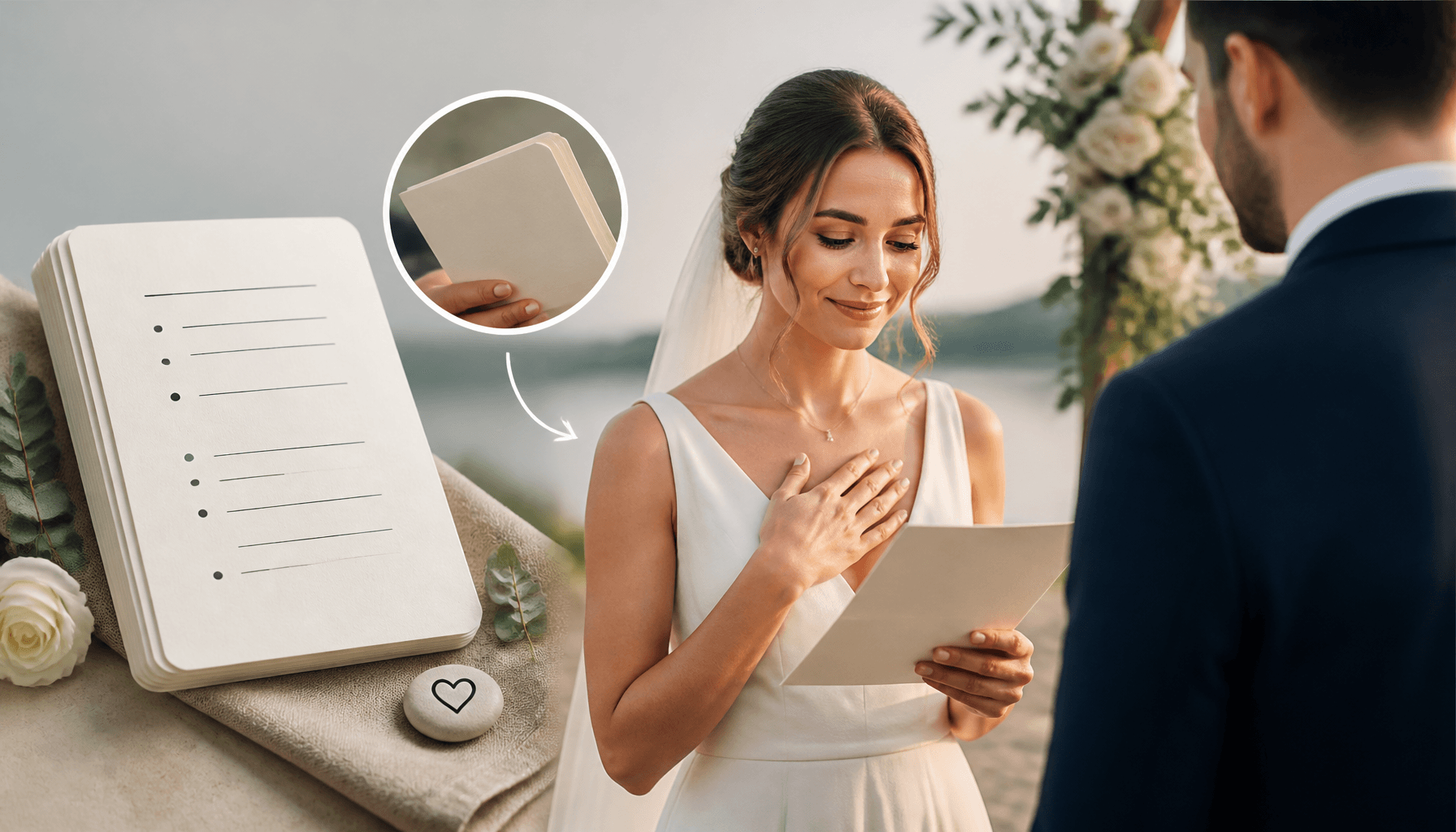
Learning how to format wedding vows for nervous readers can make the moment feel more manageable. Your reading copy should work like a friendly guide: showing you where to breathe, helping you find your place, and giving you somewhere safe to restart.
You don’t need to become a polished public speaker. You need wedding vows that sound like you—and a page that supports you. Here’s how to create a ceremony-ready script with large print, useful pause marks, and clear recovery points.
1. Make Your Wedding Vows Easy to Read at a Glance
A keepsake vow booklet and a practical reading copy have different jobs. Decorative lettering might look lovely in photographs, but your ceremony script needs to be readable at arm’s length, in the lighting where you’ll actually stand.
Start with these settings, then adjust them after reading aloud:
- Font size: Try 16–20-point type as a starting range. Go larger if you still squint or bring the page close to your face.
- Font style: Choose a familiar, clear font such as Arial, Verdana, or Georgia. Avoid script fonts for the reading copy.
- Alignment: Keep text left-aligned. Centered paragraphs make the beginning of each line harder to locate.
- Spacing: Try 1.5 line spacing and leave an extra blank line between thoughts.
- Contrast: Use dark text on plain, light-colored paper rather than a patterned background.
Print one complete thought per short paragraph. For example, give “I promise to keep choosing you, especially on the ordinary days” its own space instead of burying it between a memory and a joke.
If you’re using a small vow book, test the actual page size. Don’t shrink the font simply to fit everything onto one page; an extra page is usually a better trade-off than uncomfortable reading.
2. Add Pause Marks That Match How You Speak
Punctuation helps explain meaning, but it doesn’t always tell a nervous reader when to breathe. A few simple delivery cues can make your wedding vow script easier to follow without turning it into stage directions.
Choose a small set of marks and use them consistently:
- / means a brief pause between phrases.
- // means a longer pause after an important thought.
- [BREATHE] means stop and take an easy breath.
- [LOOK UP] means glance at your partner before continuing.
Here’s a short example:
“When I met you, / I didn’t know how much my life would change. //
[LOOK UP]
You made ordinary days feel like somewhere I wanted to stay. //
[BREATHE]
I promise to keep making that kind of home with you.”
Place pauses between complete phrases, not wherever a line happens to end. Read each sentence aloud and notice where stopping feels natural. If you run out of breath, shorten the sentence rather than adding more instructions.
Keep cues visually distinct from spoken words, and don’t mark every line. Too many symbols create another thing to manage. A handful of well-placed reminders is enough.
3. Build Easy Restart Points Into Your Vow Script
Sometimes you’ll lose your place because you’re nervous. Sometimes your partner will laugh, squeeze your hand, or start crying—and you’ll forget where you were. Format your vows so these interruptions don’t require starting over.
Divide the script into short blocks with a clear purpose: a memory, what you love, your promises, and your closing. Each block should make sense as a fresh starting point.
- Bold the first few words: Openings such as “What I love most” or “I promise” become visual anchors.
- Keep sentences together: Avoid page breaks halfway through a sentence or promise.
- Number your pages: Small labels such as “1 of 2” help if loose sheets get shuffled.
- Make the ending unmistakable: Give your final sentence its own paragraph with space above it.
For example, three separate paragraphs beginning “I promise to listen,” “I promise to laugh with you,” and “I promise to keep choosing us” provide three obvious places to resume.
If you lose your place, pause, find the next bold opening, and continue. You can also say, “Give me a moment,” without apologizing for having feelings. You don’t have to recover every skipped word for the promises to matter.
If a section remains difficult to say aloud, the wording may need simplifying. ToastPal can help you get unstuck while drafting your wedding vows, leaving you more time to make the reading copy comfortable.
4. Rehearse With Your Actual Ceremony Copy
Practicing from a laptop won’t reveal whether your printed vows are too small or awkward to hold. Rehearse standing up, using the booklet or pages you plan to bring.
Try this three-pass check:
- First pass—readability: Read at a comfortable holding distance. Enlarge any text you struggle to see.
- Second pass—delivery: Follow your pause marks and look up occasionally. Adjust cues that interrupt your natural rhythm.
- Third pass—recovery: Deliberately stop halfway through, look away, and practice finding your next restart point.
Time the spoken version, including pauses. Silent reading won’t give you a reliable ceremony estimate. Coordinate your approximate vow lengths with your partner and officiant if needed.
Finally, check page turns, avoid glare-prone paper, and bring a spare copy. Ask your officiant whether they can hold the backup so it’s available without becoming another thing you must carry.
A Clear Page Helps You Stay Present
Formatting wedding vows for nervous readers comes down to three essentials: readable large print, meaningful pause marks, and easy restart points. Test them with your actual ceremony copy, and keep what genuinely helps.
Your vows don’t need flawless delivery. A clear, forgiving script simply makes it easier to look up, reconnect with your partner, and say what you came to promise.