How to Write a Maid of Honor Speech That Wows (ToastPal Guide)
How to Write & Deliver a World-Class Maid of Honor Speech (ToastPal Guide)
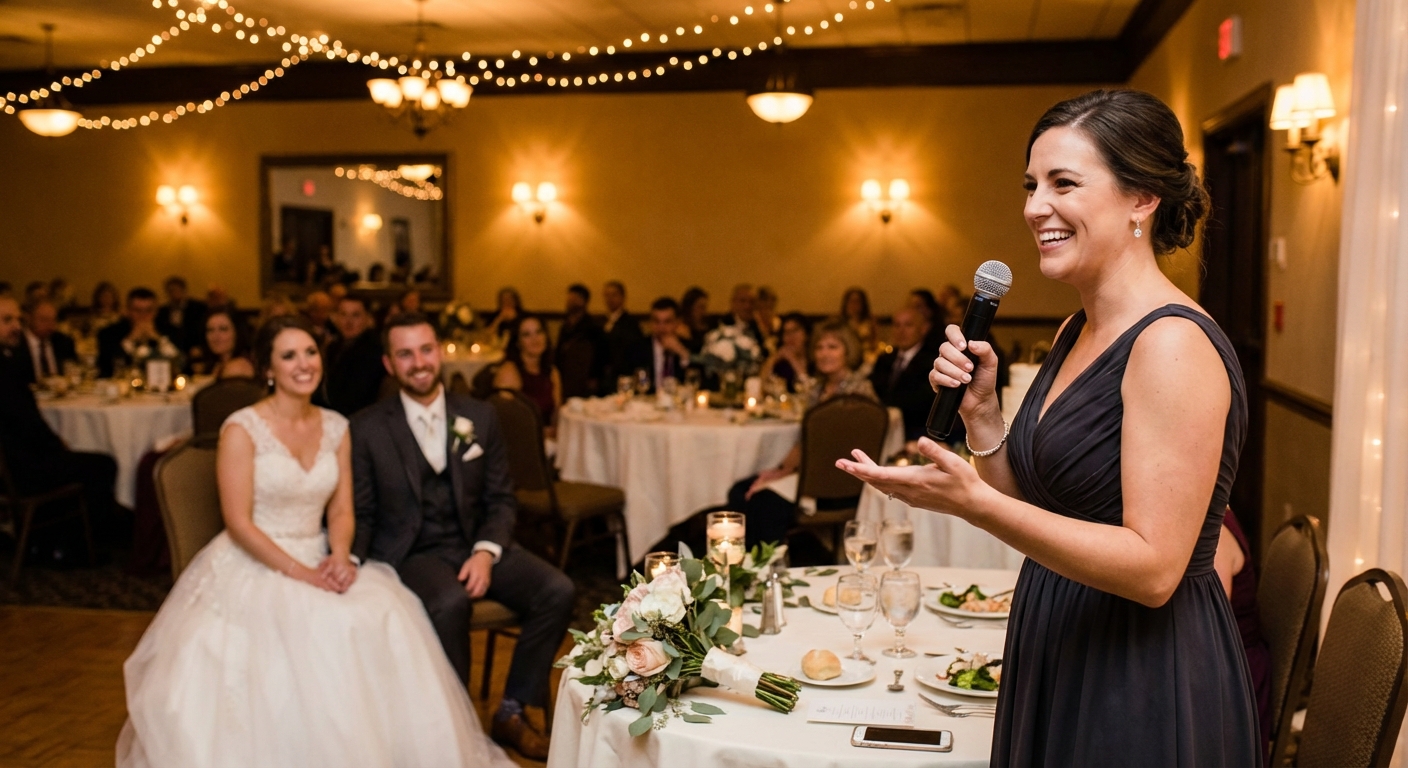
If you feel honored, excited, and slightly nauseous at the thought of giving your Maid of Honor speech, you are in excellent company. Being asked to stand beside your best friend on one of the biggest days of her life is a testament to your bond. However, the task of delivering a speech that does justice to that friendship can feel overwhelming. You have to say a few meaningful words that capture years of memories, inside jokes, and shared tears, all while standing in front of a room full of expectant guests.
The job is simple in theory but terrifying in practice. You want to be funny but not embarrassing. You want to be sentimental but not sappy. Most of all, you want to avoid staring at a blank page while the wedding date creeps closer. If you are wondering how to condense a lifetime of friendship into three coherent minutes, you do not have to do it alone. ToastPal uses advanced AI to help you articulate your unique bond, turning your memories into a polished, heartfelt speech in minutes.
The speeches that go viral on TikTok and Instagram are not accidents. They do not rely on luck or professional acting skills. They share three specific DNA traits that work both in the room and on video: confidence, storytelling, and brevity. They are not long lists of compliments or rambling timelines of your friendship. They are emotionally specific narratives that land with precision.
This guide walks you through the exact formula that makes speeches memorable. We will cover the simple 3-minute structure, the delivery secrets that build confidence, and a practical plan to turn nerves into poise. By the end, you will know exactly how to craft a speech that does not just survive the moment but becomes the moment everyone remembers.
The Anatomy of a Viral Speech: Why Less Is More
A world-class Maid of Honor speech is not about using more words. It is about making better choices. The most common mistake speakers make is thinking they need to tell the entire history of the friendship. This approach often leads to rambling, losing the audience, and diluting the emotional impact.
The Ideal Length: Short Enough to Sparkle
Most wedding experts recommend keeping a Maid of Honor speech in the 2 to 5 minute range. That is long enough to make people feel something but short enough to avoid audience drift. The reason is not just etiquette; it is psychology. Engagement peaks early. People lock in at the beginning, but their focus drops as time goes on, especially when there are distractions like food service or clinking glasses.
Data on audience attention spans suggests that engagement drops significantly after the first few minutes of a presentation. If you want maximum impact, you must earn it fast and end clean. Aim for three minutes as your default. This constraint is your superpower because it forces every line to justify its existence.
Emotional Specificity Beats Generic Praise
There is a reason saying "She is the nicest person ever" does not get quoted later. It is too broad to picture. Viral speeches do something different. They prove the point with one vivid, concrete moment.
Consider the difference between these two statements:
- Generic: "She is always there for people."
- Specific: "When my car died at 11 p.m. in the rain, she showed up in her pajamas with jumper cables and hot coffee."
Specificity creates a mental movie. A mental movie creates emotion. Emotion creates memory. When you choose one or two intimate anecdotes, you avoid the trap of trying to summarize everything. Your job is not to write a biography. Your job is to reveal who she is through a specific lens.
The "Scroll-Stopping" Rhythm
Whether you are speaking to a ballroom or a camera, rhythm matters. The most rewatchable speeches use short sentences for punchlines and slightly longer sentences for storytelling. They use pauses to let laughter and emotion breathe. They use contrast between humor and tenderness so the room feels the shift.
A good rule of thumb is that if you would not want to caption it on social media, you should tighten it. If you cannot imagine someone quoting it, it might be filler.
The 3-Minute Formula: Hook, Story, Toast
You do not need to be a professional writer to sound like one. You just need a container for your thoughts. The easiest container is a simple structure that mirrors what humans naturally enjoy: setup, change, and resolution. This is often referred to as a wedding speech, and it provides a clear roadmap for your speech.
Part 1: The Hook (0:00 to 0:30)
Your hook has one job, and that is to make the room lean in. Avoid the classic slow start of "For those of you who don't know me..." It wastes your strongest attention window and makes you sound like you are stalling. The audience likely knows who you are, or the MC has just introduced you.
Start with a surprising truth, a warm welcome, or a confident claim.
- "If you know the bride, you know she has two superpowers: showing up and making people feel brave."
- "I have loved her in a hundred versions of life, and she has been the same kind of extraordinary in every one."
Then, name who you are in one clean line. "I’m Sarah, Emily’s best friend, and the luckiest person to stand beside her today." That is all you need to set the stage.
Part 2: The Story (0:30 to 2:30)
This is the heart of your speech. It is where you move from introduction to emotion. Use a three-beat arc that is easy for everyone to follow: where she began, what changed, and where she is now.
Step 1: Choose One Theme
A theme is your speech’s invisible glue. Pick one quality that defines her. Is it her steadiness? Her courage? Her joy? Once you have a theme, every anecdote you choose must support it. If a story is funny but does not fit the theme, it belongs in a different speech.
Step 2: Pick One Main Anecdote
Viral speeches typically hinge on one anchor story. You can add a small supporting detail, but do not stack five different stories on top of each other. A strong anchor story has a setting, a small problem, and a choice she made that reveals her character.
For example, "One of my favorite things about Emily is her calm under pressure. I learned that when we got lost in Europe with no map and no phone battery. While I panicked, she found a local bakery, ordered us pastries, and made friends with the owner who eventually drove us home. That is who she is."
Step 3: Weave the Partner In
A Maid of Honor speech is about the bride, but it must honor the couple. The most graceful way to include the partner is to show fit rather than flattery. Connect him to her theme. "And then she met Jake, and I watched that steadiness meet someone who matched it." This approach is emotionally specific and deeply complimentary.
Part 3: The Toast (2:30 to 3:00)
A strong toast is short, clear, and quotable. It is not a second speech. The best closings name what you wish for them, keep it simple enough to remember, and cue the room with a clear instruction.
A reliable toast formula is: "May your love be [one value], your home be [one feeling], and your life be [one image]."
Then land the plane. "Please raise your glass to the happy couple." Stop. Smile. Drink. You are done.
Writing Your Speech: From Blank Page to Polished Draft
Writing feels hard when you think you need to capture everything perfectly in the first draft. You do not. You just need to capture something real.
Brainstorming Phase
Start by setting a timer for 12 minutes. Write bullet points only. Do not worry about full sentences or grammar. List memories, feelings, and "her" things. Prompts like "The moment I realized she would always be in my life was..." or "The way she loves her people looks like..." can help unlock ideas.
Brides’ Maid-of-Honor Toast guide emphasizes practical steps for brainstorming, outlining, and rehearsing. This method takes the pressure off and allows your best ideas to surface naturally.
Balancing Humor and Sentiment
The best Maid of Honor speeches make people laugh and then feel something immediately after. The emotional payoff is bigger when the room is relaxed. Use contrast to achieve this. Follow a quick laugh line with a sincere statement.
"She once made a spreadsheet for our vacation that was color-coded down to the minute. But honestly, that is who she is. She plans because she cares, and she cares in a way that makes everyone around her feel looked after." That is humor plus tenderness, with the tenderness doing the heavy lifting.
The "Cut" List
If you want a world-class speech, you have to protect it from bloat. Be ruthless with your editing. Cut long introductions that delay the hook. Remove lists of bridesmaids, parents, and venue staff; there are other times for those thank-yous. Delete anything that requires context only you and the bride have.
Most importantly, Crafting a world-class Maid of Honor speech means removing stories where the punchline is "you had to be there." If the audience has to work too hard to understand the joke, you will lose them.
Delivery Masterclass: Confidence, Eye Contact, and Pacing
A great speech on paper can fall flat if it is rushed, mumbled, or read like a text message. Delivery is not about being a natural performer. It is about mastering a few repeatable skills.
The Confidence Mindset
If your hands shake a little, welcome to being human. public speaking anxiety is extremely common, with roughly 75% of people experiencing some level of fear around speaking. Normalizing this matters because it keeps you from interpreting nerves as failure. Nerves are just your body preparing for a meaningful moment.
Here is the reframe that changes everything. You are not performing. You are serving the couple. When you focus outward on honoring your friend, the anxiety shrinks.
The Delivery Checklist
Use this checklist as your run-of-show for the big day.
Confidence and Posture: Plant both feet firmly. No swaying. Keep your shoulders down and your chest open. Hold your notes at mid-torso level, not up in front of your face. Smile once before you start speaking. It signals calm to the room and to your own brain.
Eye Contact: Use the "triangle" method. Look at the bride for one sentence. Look at the partner for one sentence. Look at the room for one sentence. Repeat. This prevents you from locking onto one person and makes the whole room feel included. Do not read off your phone.
Pacing and Pauses: Speak 15 percent slower than you think you should. Nerves make you speed up naturally. Pause after punchlines to let the laughter land. Pause after emotional lines to let the sentiment sink in. If you feel yourself rushing, take a sip of water and restart the sentence calmly.
Mic Use: Hold the microphone like an ice cream cone, not a champagne flute. Keep it close to your mouth, about a fist’s distance away. Do not point it at your chest when you laugh. Laugh with the mic still near your mouth so the room stays with you.
Authenticity Beats Perfection
Viral speeches do not feel robotic. They feel real. It is okay to tear up. It is okay to laugh mid-sentence. It is okay to pause to breathe. If you stumble, just smile and keep going. The audience is rooting for you.
The Practice Plan: 7 Days to Perfection
You do not need months to prepare, but you do need a plan. The goal is not memorization; it is familiarity. wedding speech tips focusing on public speaking techniques, staying on topic, and thoughtful preparation are key to a successful toast.
Day 7: Build the Draft
Write your Hook, Story, and Toast sections. Read it out loud once and time it. Do not edit while reading. Just notice where you stumble. Aim for 3 to 4 minutes on this day.
Day 6: Tighten for Rhythm
Cut anything that is not emotionally specific. Replace abstract compliments with concrete details. Mark where the room will likely laugh and add a pause notation.
Day 5: Cue Cards
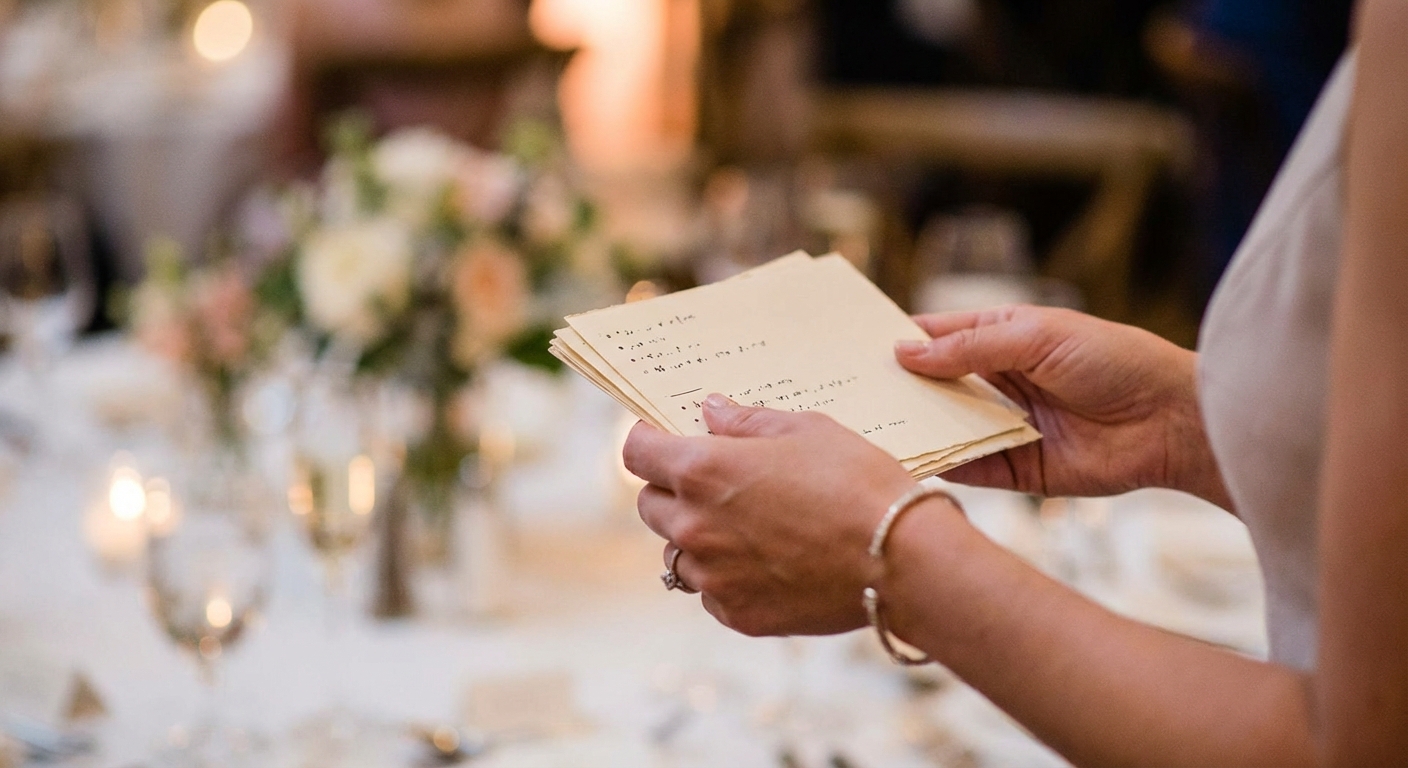
Move your speech onto 3 to 5 small cue cards. Use bold keywords, not paragraphs. Practice looking up after every sentence. Your eyes should be up more than they are down.
Day 4: Stage Directions
Write delivery cues directly into your notes. Add instructions like [pause], [look at bride], [smile], or [raise glass]. This is how you make pacing feel intentional.
Day 3: Record Yourself
Record a single run on your phone. Watch it like a coach. Are you speaking too fast? Can you hear every word? Are you smiling? Do one more run with one improvement only.
Day 2: Mock Toast
Hold a glass in your non-mic hand. Stand up. Practice the exact opening and the exact closing three times each. Your first 20 seconds and last 20 seconds should feel automatic.
Day 1: Calm Rehearsal
Do two gentle run-throughs only. Stop editing. Editing late increases anxiety and makes you second-guess yourself. Hydrate, eat, and sleep.
Nerve-Calming Techniques
Right before you speak, try box breathing. Breathe in for 4 counts, hold for 4, out for 4, hold for 4. Repeat this cycle a few times to lower the physical symptoms of anxiety. Remind yourself: "I feel nervous because I care. I am here to honor her."
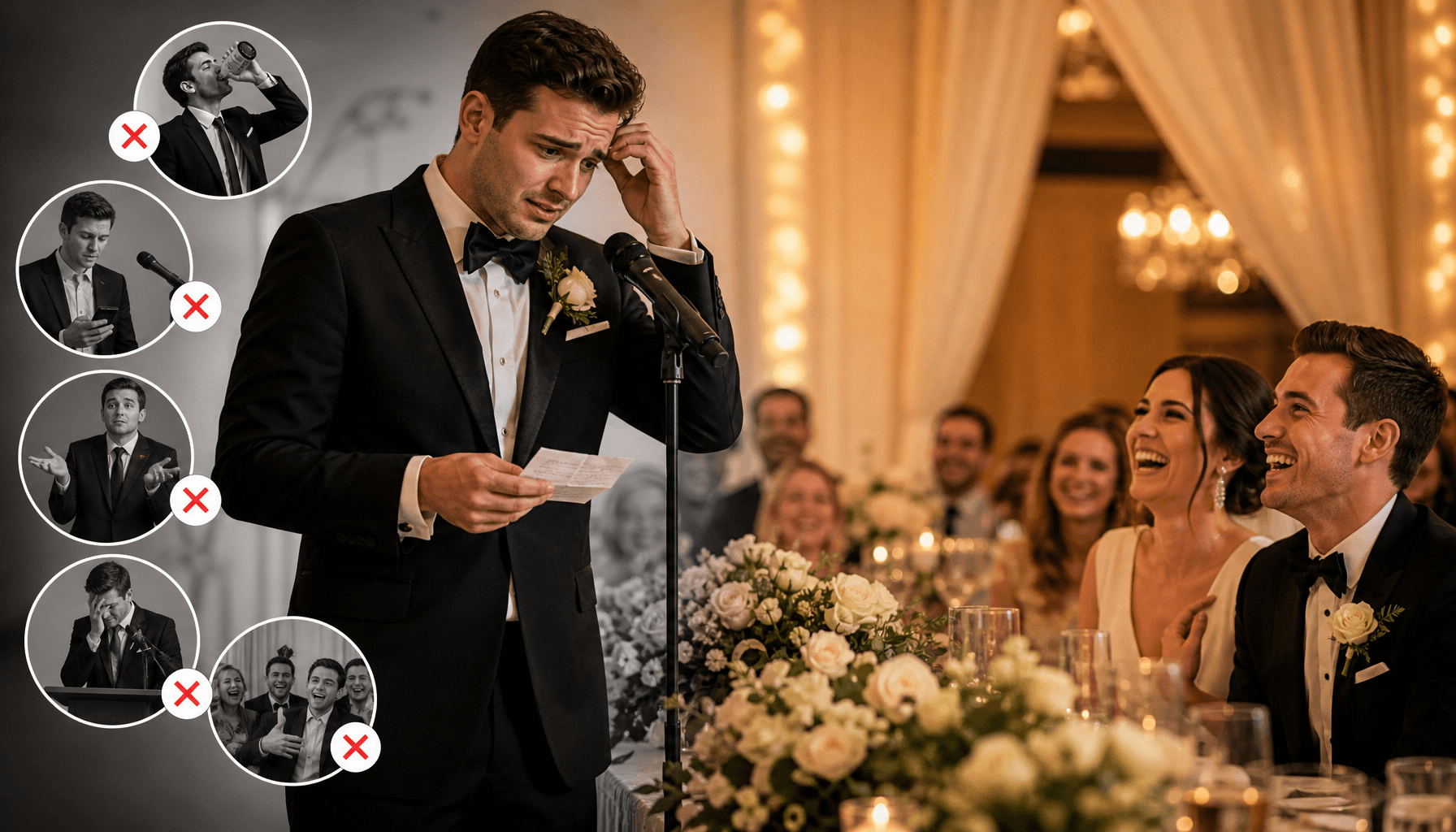
Common Mistakes to Avoid (The "Do Not" List)
This section saves weddings. Avoiding these common pitfalls ensures your speech is remembered for the right reasons.
Inside Jokes
If the audience needs context, it is not a joke; it is a private conversation on a microphone. You can nod to the closeness of your friendship without confusing the guests. Instead of referencing "the pineapple incident," say, "We have had our share of adventures that are best left unexplained."
Mentioning Exes
Never do this. Not once. Not even as a joke. It instantly shifts the energy in the room and puts the couple in an awkward spotlight. Keep the focus entirely on the future and the person she is with now.
Rambling
Winging it is how sweet speeches turn into 9-minute diary entries. Your best friend deserves a clean, confident moment, not a live brainstorming session. Have a script. Have cue cards. Know your ending line.
Making It About You
Your perspective matters, but you are not the main character. Too many "I" statements can pull focus away from the couple. Keep "I" for the setup of a story, shift to "she" for the meaning, and land on "you two" for the future.
How ToastPal Can Help You Shine
You now have the ingredients that make a Maid of Honor speech feel world-class. You understand the structure that creates emotional movement, the importance of specific storytelling, and the balance of humor and tenderness. You have a delivery plan that reads as confident even when you are nervous.
However, if you are still struggling to find the right words or feeling the pressure of the deadline, you do not have to struggle alone. ToastPal is your secret weapon. The platform is designed to take your raw memories and natural voice and generate a polished draft in minutes. It helps you overcome writer's block and ensures your speech is heartfelt, funny, and uniquely yours.
Don't let the stress of writing ruin the anticipation of the big day. Start drafting your perfect speech today and step up to the microphone with confidence.
Frequently Asked Questions
How long should a Maid of Honor speech be?
A Maid of Honor speech should ideally be between two and five minutes long. Three minutes is often considered the sweet spot. This length allows you to tell a meaningful story without losing the audience's attention or disrupting the flow of the reception.
Should I memorize my Maid of Honor speech?
Memorization is not required and can sometimes add unnecessary pressure. It is often better to know your speech well but use cue cards for support. This allows you to stay present and authentic without the fear of forgetting your lines.
What is the best way to start a Maid of Honor speech?
Start with a confident hook that grabs attention immediately. Avoid generic openings like "For those who don't know me." Instead, open with a surprising fact, a warm welcome, or a specific observation about the bride that sets the emotional tone.
Can I use notes during my speech?
Yes, using notes is perfectly acceptable and often looks more professional than rambling. Small index cards are the best tool. Avoid reading from a phone screen, as the backlight can be distracting and it can look like you are checking texts.
How do I stop being nervous before my speech?
While you may not eliminate nerves completely, you can manage them. Practice your speech out loud multiple times. Use breathing techniques like box breathing right before you speak. Focus on the bride and your desire to honor her, rather than on your own performance.