The 2-Minute Drill: Master Short Best Man Speeches Fast

The "2-Minute Drill": How to Give an Impactful Best Man Speech When You Are Short on Time
You have been named best man. Congratulations. Now comes the part that makes your palms sweat: the speech. Maybe the wedding planner has given you a strict two-minute limit. Maybe you have procrastinated until the week before the wedding. Or maybe you simply know that keeping it short is the smartest move. Whatever brought you here, you are in the right place.
Here is the truth that will set you free: a short best man speech is not a compromise. It is a strategic advantage. Brevity is your superpower. While other speakers drone on for ten minutes, losing the room halfway through, you will deliver a knockout toast that leaves everyone wanting more. And if you are staring at a blank page wondering where to start, ToastPal's Best Man Speech service can transform your scattered thoughts into a polished, heartfelt tribute in minutes.
The myth that longer equals better has ruined countless wedding receptions. Guests shift in their seats. The couple smiles politely while mentally calculating how much longer until dancing starts. The truth is that most people cannot sustain attention for lengthy speeches, and wedding guests especially want to celebrate rather than sit through a lecture.
This guide will teach you the "2-Minute Drill," a high-impact approach to toasting that maximizes emotional punch while respecting everyone's time. You will learn the exact structure, discover how to pack humor and heart into every sentence, and walk away with templates you can customize tonight. By the end, you will understand why short best man speeches consistently outperform their longer counterparts, and you will have the tools to deliver yours with confidence.
Why "Short and Sweet" Wins Every Time: The Science of Attention
Let us talk science. Research from the American Psychological Association (APA) discusses research on attention spans, highlighting that sustained listening attention often drops after 5 to 10 minutes. Think about it. When was the last time you genuinely paid attention to a ten-minute monologue at a party? Your guests are there to celebrate, eat, drink, and dance. They love the couple, but their attention span for speeches is limited.
The sweet spot for wedding speeches sits right around two to three minutes. This is not arbitrary. It is based on how our brains process spoken information in social settings. When content exceeds this window, engagement plummets. People start checking phones, refilling drinks, or simply zoning out. Your brilliant story about the groom's college days gets lost in the mental fog of minute seven.
Here is the math that matters. The average comfortable speaking rate ranges from 130 to 160 words per minute. At this pace, a two-minute speech contains approximately 260 to 320 words. A three-minute speech stretches to roughly 390 to 480 words. These are not massive blocks of text. They are tight, focused narratives that demand every word earn its place.
Short best man speeches force clarity. You cannot meander through five different stories. You cannot thank everyone individually. You must choose your best material and deliver it with precision. This constraint actually improves quality. A review in a physiology journal suggests breaking long content into micro-chunks to maintain attention, supporting the strategy of short, targeted speeches. Your two-minute speech becomes a perfectly portioned serving of entertainment and emotion.
Consider the audience perspective. Wedding guests have already sat through a ceremony. They have made small talk during cocktail hour. They are ready for the fun part of the evening. A concise speech signals respect for their time. It says that you value this moment enough to make every second count. That respect translates into appreciation and engagement.
The couple will thank you too. They are managing a complex event with dozens of moving parts. A best man who delivers a tight, memorable speech and then sits down becomes a hero. You have contributed to the celebration without derailing the timeline. You have given them a moment they will remember without giving them anxiety about the schedule.
The Anatomy of a Perfect 2-Minute Speech
Now for the blueprint. A two-minute speech is not a random collection of thoughts. It is a carefully architected experience with four distinct sections, each serving a specific purpose. Master this structure, and you will never struggle with speech writing again.
The Killer Opener (0:00 to 0:30)
Your first thirty seconds establish everything. Who you are, how you know the groom, and why people should listen. This is not the time for long preambles or nervous rambling. Jump straight into your identity and relationship.
Example: "I am Jake, and I have had the privilege of being Tom's best friend since we were seven years old and he convinced me that jumping off the garage roof with trash bags as parachutes was a good idea."
Notice what this does. It identifies the speaker, establishes the relationship, and lands a quick laugh. Thirty seconds. Done. You have earned the room's attention.
The opener can also be a surprising statement or observation. You might say, "When Tom first told me he was getting married, I thought he was joking. Not because he isn't ready, but because I had never seen him this happy, and I wasn't sure it was legal to be that cheerful before noon."
Whatever approach you choose, keep it tight. No long thank-yous to everyone in the room. No meandering introductions. Get in, establish your credentials, and move forward.
The Meat: The Story (0:30 to 1:30)
This is your centerpiece. One singular, powerful anecdote that reveals the groom's character. Not three stories. Not a chronological biography. One story that does heavy lifting.
The key word here is "singular." Many best men try to cram in multiple anecdotes, thinking more equals better. Wrong. One well-told story with a clear beginning, middle, and end will always beat three rushed, half-developed tales.
What makes a good story? It should reveal something true about the groom. Maybe it is his loyalty, his sense of humor, his unexpected kindness, or his ability to turn disasters into adventures. The story does not need to be dramatic. It needs to be revealing. Bridebook recommends a 3-minute formula for short wedding speeches where you dedicate the bulk of your time to the story, and they are absolutely right. This is where emotional connection happens. This is what people remember.
Example: "Last year, Tom and I went camping. Halfway through the first night, we realized we had forgotten the tent poles. Most people would have driven home. Tom looked at me, grinned, and said, 'We are engineers. We will figure it out.' Two hours later, we had built a shelter using fishing line, duct tape, and sheer stubbornness. It held through a rainstorm. That is Tom: when things go wrong, he doesn't panic. He problem-solves, he laughs, and he makes it work."
This story takes about sixty seconds to tell at a comfortable pace. It is specific, visual, and reveals character. The audience can picture it. They understand who Tom is through action, not description.
The Pivot to the Partner (1:30 to 1:45)
Now shift focus. You have established the groom's character. Time to acknowledge how the partner complements or enhances that character. This transition should feel natural, not forced.
Example: "And then Sarah came along. Suddenly, Tom didn't need duct tape and fishing line to hold things together. Sarah brings out the best in him. She matches his problem-solving with patience. She meets his energy with calm. Together, they are not just solving camping disasters. They are building a life."
Fifteen seconds. That is all you need. A genuine compliment to the partner and a recognition of what they bring to the relationship. Do not overdo it. Do not make it saccharine. Keep it real and keep it brief.
The Toast (1:45 to 2:00)
Your closing fifteen seconds should be memorable, warm, and definitive. Raise your glass. Make your final wish. Sit down.
Example: "So here is to Tom and Sarah. May your adventures together be slightly less chaotic than camping without tent poles, and may you always face challenges with the same humor, love, and determination you have shown us today. To the happy couple!"
That is it. Clean, heartfelt, and complete. No rambling. No last-minute additions. You have delivered a complete emotional arc in two minutes. Understanding where your speech fits into the broader evening helps too. Knowing your Best Man duties ensures you are prepared for timing, positioning, and audience expectations. The speech is not isolated. It is part of a choreographed celebration.
Packing a Punch: Humor and Sentiment in Limited Time
Short speeches demand efficiency in emotion. You cannot waste time on long setup jokes or elaborate explanations. Every element must deliver immediate impact. This is where the "Rule of Three" becomes your best friend.
The Rule of Three is a comedic structure: Setup, Setup, Punchline. It works because our brains recognize patterns. Two setups establish the pattern. The third breaks it, creating surprise and laughter. Science of People's best man speech guide emphasizes the 'rule of three' for humor and effective delivery, and for good reason. It is fast, reliable, and universally understood.
Example: "Tom is organized. Tom is punctual. Tom once showed up to his own surprise party an hour early because he 'wanted to help set up.'"
Three beats. Immediate laugh. No wasted words.
Compare that to a meandering joke that requires backstory about a specific apartment, a neighbor, and a radiator. By the time you reach the punchline, half the room has mentally checked out. The Rule of Three keeps everyone engaged because the payoff comes quickly.
Cutting the fluff matters just as much as good structure. Inside jokes that require two minutes of explanation must go. Thank-yous to people who have already been thanked by the Father of the Bride are unnecessary. Stories that make sense only if you were there should be deleted.
Your goal is universal accessibility. Every guest should understand and enjoy your speech, whether they have known the groom for twenty years or met him at the rehearsal dinner. This does not mean your speech becomes generic. It means you choose stories and jokes with broad appeal.
Balancing humor and heart requires intentional contrast. Start with a laugh, then pivot to sincerity. The emotional shift creates impact. Audiences remember moments where they laughed and then immediately felt something deeper.
Example: "Tom has always been the guy who makes everything fun. He turns grocery shopping into an adventure and traffic jams into comedy shows. But when his mom was sick last year, I watched him become someone even more remarkable. He showed up every day. He stayed strong when it was hard. He proved that behind all the jokes is a man of incredible depth and loyalty. Sarah, you are marrying someone truly special."
That is the contrast. Humor establishes likability. Sentiment reveals depth. Together, they create a complete portrait that resonates emotionally. For more strategies on connecting with your audience and delivering humor effectively, exploring Roast & Toast techniques can sharpen your delivery even further.
3 Micro-Templates for Short Best Man Speeches
Templates are not crutches. They are frameworks that free you to focus on content rather than structure. Here are three distinct approaches, each roughly 300 words, designed for different tones and relationships.
For more variety, you can check out these Short Best Man Speeches templates.
Template 1: The "Roast & Toast" (Humor Focused)
Good evening, everyone. I am [Your Name], and I have known [Groom] since [context]. When he asked me to be his best man, I immediately said yes, mostly because I knew it would give me a microphone and a captive audience.
Let me tell you about [Groom]. He is the kind of guy who [funny characteristic]. I once watched him [brief funny anecdote that reveals character flaw in an endearing way]. Most people would have been embarrassed. [Groom] turned it into a story he still tells at parties.
But here is what you need to know about [Groom]: beneath the [humorous trait] is someone genuinely [positive quality]. When [brief example of groom showing this quality], I realized he is not just funny. He is loyal, kind, and one of the best people I know.
And then [Partner] came into his life. [Partner], you have done something I did not think possible: you have made [Groom] even better. You bring out his [positive quality]. You balance his [humorous trait] with [partner's complementary quality]. Together, you are proof that the right person does not complete you, they complement you perfectly.
So here is to [Groom] and [Partner]. May your life together be filled with laughter, adventure, and just enough chaos to keep things interesting. May you always find reasons to laugh, especially at each other. And may you never stop being exactly who you are, because who you are together is pretty damn great. To the happy couple!
Template 2: The "Brotherly Bond" (Sentimental Focused)
Hello, everyone. I am [Your Name], [Groom]'s [brother/childhood friend]. Standing here tonight, I am thinking about all the moments that brought us to this day.
I remember [specific childhood or early memory]. Even then, [Groom] was [characteristic]. He has always been the person who [example of character trait]. That has not changed. What has changed is that he has found someone who truly sees him.
[Partner], from the moment [Groom] introduced us, I knew you were different. The way he talks about you, the way his whole face lights up when you walk into a room, I have never seen him like that. You have brought out something in him that I am not sure even he knew was there.
I have watched you two navigate [challenge or experience]. I have seen how you support each other, how you laugh together, how you have built something real and strong. That is what marriage is: choosing each other every day, through the easy moments and the hard ones.
[Groom], I am proud to call you my [brother/friend]. [Partner], I am grateful to call you family. Here is to a lifetime of love, partnership, and the kind of happiness that makes everyone around you smile. To [Groom] and [Partner]!
Template 3: The "Short & Classy" (Formal)
Good evening. I am [Your Name], and I have the honor of serving as [Groom]'s best man.
I have known [Groom] for [time period], and in that time, I have come to deeply respect his [quality], his [quality], and his unwavering [quality]. He approaches life with [characteristic], and he treats people with [characteristic].
When [Groom] told me about [Partner], I heard something in his voice I had never heard before. He had found someone who matched his values, who shared his vision for the future, and who made him want to be even better than he already was.
[Partner], you are gracious, intelligent, and kind. You have brought immeasurable joy to [Groom]'s life and to all of ours. Together, you represent the best of what partnership can be: mutual respect, shared purpose, and genuine love.
Marriage is a profound commitment. It is choosing to build a life together, to face challenges as a team, and to celebrate victories side by side. I have no doubt that you two will honor that commitment with the same integrity and grace you have shown in everything you do.
Please join me in raising your glasses to [Groom] and [Partner]. May your marriage be filled with love, laughter, and a lifetime of happiness. Cheers!
The Rehearsal Checklist: Delivering with Confidence
A great speech on paper can fail in delivery. Short best man speeches require precision because every word matters. There is no room for filler or recovery time if you stumble. Rehearsal transforms a good speech into a great performance.
Speed Control
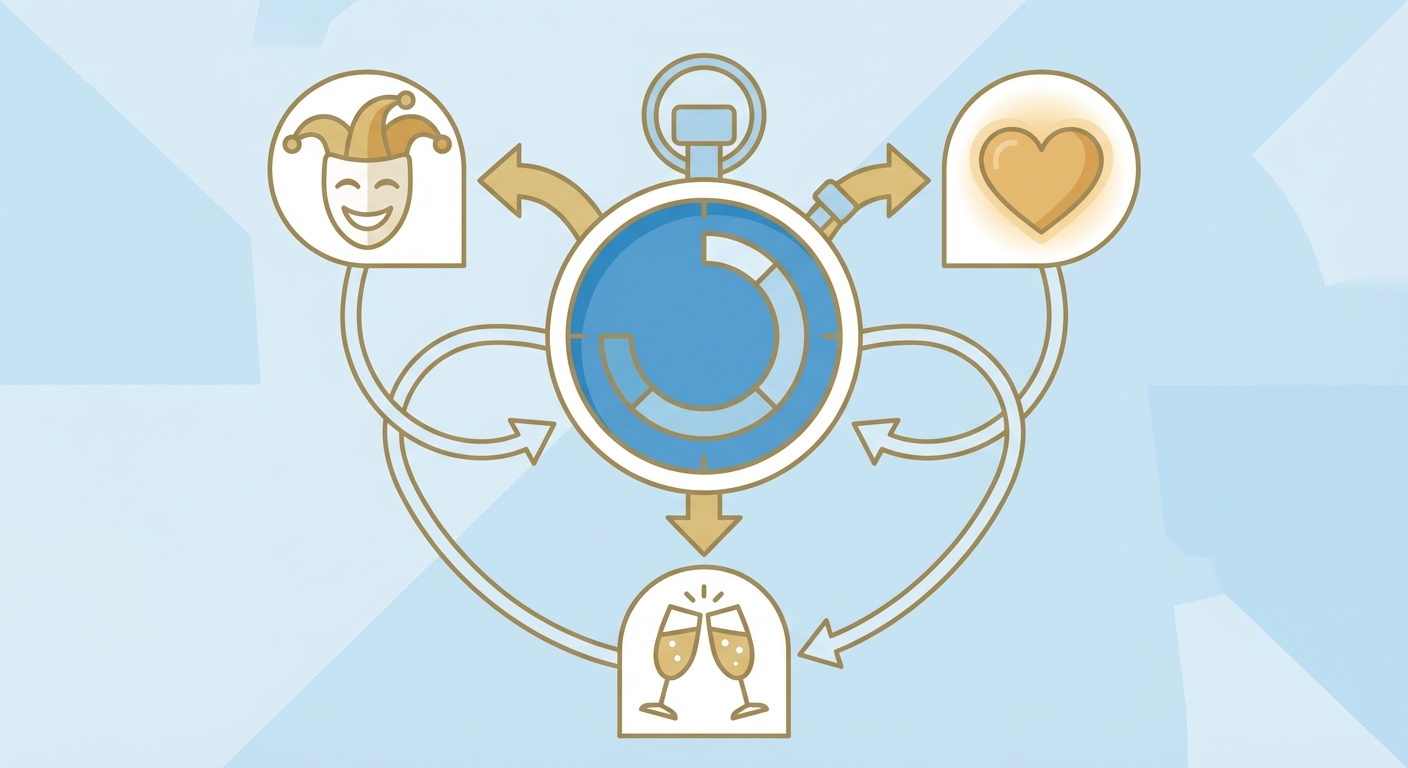
The number one mistake nervous speakers make is rushing. Anxiety accelerates your internal clock. What feels like a normal pace to you sounds like an auctioneer to your audience. A two-minute speech delivered at panic speed becomes a ninety-second blur where nobody catches the jokes or feels the sentiment.
Practice at 75% of your natural speaking speed. It will feel uncomfortably slow during rehearsal. It will sound perfect during delivery. Record yourself. Listen back. If you cannot understand every word clearly, you are going too fast.
The Power of the Pause
Pauses are where humor and emotion land. After a punchline, pause. Let the laughter come. Do not rush into your next sentence trying to fill the silence. The pause is part of the joke's structure.
After a sentimental statement, pause. Let the weight of the words settle. Give people a moment to feel what you have said before moving forward. Silence is not awkward. It is emphasis.
Practice your pauses deliberately. Mark them in your notes if necessary. "Pause for laugh." "Pause for effect." These are not suggestions. They are essential elements of delivery.
The Complete Rehearsal Checklist
- Time yourself reading the speech aloud at a comfortable pace
- Aim for 2:15 in practice to account for laughter and pauses
- Record yourself and listen for clarity and pacing
- Practice the pause after each punchline (count to two)
- Mark emotional beats where you will slow down
- Rehearse your eye contact pattern (couple, room, couple)
- Practice holding the microphone correctly
- Run through the speech standing up, as you will during delivery
- Do a final run-through the morning of the wedding
- Bring note cards as backup, but aim to deliver without them
Even with preparation, nerves happen. Understanding techniques for delivering with confidence can help you stay calm and focused when it is time to take the mic. Remember that everyone in that room wants you to succeed. They are rooting for you.
When to Call in the Pros: Using AI to Save Time
Sometimes, despite your best intentions, the words do not flow. You understand the structure. You know what you want to say. But translating those ideas into a polished speech feels impossible. Writer's block hits hard, especially when you are juggling bachelor party planning, wedding logistics, and your regular life responsibilities.
This is exactly when ToastPal becomes invaluable. This is not about taking shortcuts. It is about leveraging technology to overcome the blank page problem that paralyzes so many best men.
The "Tone" selector is particularly powerful for short speeches. You can specifically request "Short and Punchy" or "Under 3 Minutes" as parameters. The AI understands that brevity requires different structural choices than longer speeches. It prioritizes your strongest material and eliminates filler automatically. ToastPal's AI features provide the framework and polished language, while you provide the final personal touches.
Conclusion
A short best man speech is not a consolation prize. It is a strategic choice that respects your audience, honors the couple, and maximizes your impact. In two minutes, you can make people laugh, make them feel, and make them remember why they are celebrating.
The guests will thank you for respecting their time. The couple will thank you for contributing to their celebration without derailing it. And you will walk away knowing you delivered something truly memorable.
Ready to knock your speech out of the park in under two minutes? Do not let writer's block steal your confidence. Let ToastPal's Best Man Speech service write the perfect draft for you today. Transform your scattered thoughts into a polished, heartfelt tribute that will make everyone in that room smile. Your best man speech is too important to leave to chance. Start crafting yours now.
FAQ
How many words is a 2-minute best man speech?
A two-minute best man speech typically contains between 260 and 320 words, based on an average speaking pace of 130 to 160 words per minute. This length allows you to deliver a complete narrative arc with an introduction, one strong story, acknowledgment of the partner, and a closing toast without rushing or losing audience attention.
Is a 2-minute best man speech too short?
No, a two-minute best man speech is often the ideal length. Research shows that audience attention for spoken content drops significantly after five to ten minutes, making shorter speeches more engaging and memorable. Quality matters far more than quantity. A focused, well-delivered two-minute speech will resonate more deeply than a rambling ten-minute monologue.
Can ToastPal write a speech under 3 minutes?
Yes, ToastPal's AI allows you to customize both the length and tone of your speech. You can specifically request a speech under two or three minutes, and the AI will structure content accordingly, prioritizing your strongest material and eliminating unnecessary filler.