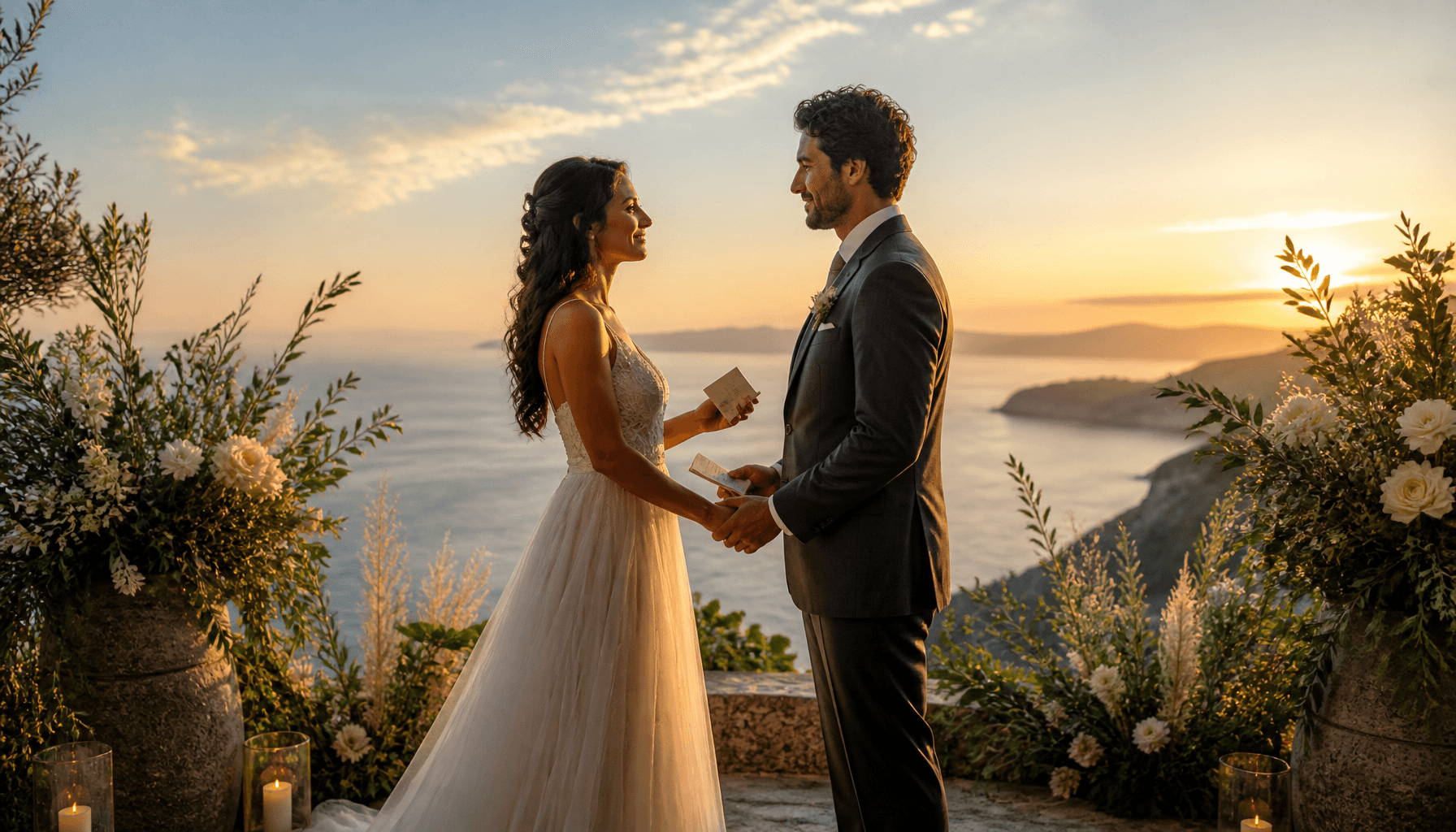
Wedding Vow Anxiety: Where to Look When Eye Contact Makes You Lose Your Words
You’ve practiced your wedding vows without a single stumble. Then you picture your partner standing in front of you, eyes shining, and suddenly you can’t remember what comes after “I love you.” The problem isn’t that your promises aren’t heartfelt. Looking at the person they’re meant for can make those words feel much bigger than they did in your kitchen.
Wedding vow anxiety doesn’t require you to choose between meaningful eye contact and getting through your speech. You can plan where to look, put those choices into your script, and prepare a simple way back if emotion interrupts. Here’s how to deliver personal wedding vows without making an unbroken gaze another promise you have to keep.
1. Choose a Comfortable Place to Look Before the Ceremony
There is no required amount of eye contact during wedding vows. Reading from a vow book isn’t less sincere than speaking from memory, and looking away briefly doesn’t make your promises less personal. The useful question is: where can you look while still feeling connected enough to speak?
Use three possible visual anchors
- Your vow page: Make this your reliable home base. Look down whenever you need the exact wording, especially for a longer sentence.
- A nearby point on your partner’s face: Try the bridge of their nose, an eyebrow, or their cheek. Some people find this less intense than direct eye contact; others don’t, so test it rather than assuming it will help.
- Your partner’s eyes: Save direct eye contact for a few short lines if that feels comfortable. You might choose their name, one central promise, and your final sentence.
Avoid choosing an anchor that adds another distraction. Looking toward your most emotional relative may undo your composure faster than looking at your partner. A camera can make you newly aware of being watched.
If eye contact is uncomfortable for sensory, cultural, or personal reasons, you don’t need to force it. Facing your partner, speaking audibly, and choosing specific promises can communicate connection without sustained eye contact.
2. Build a “Read, Lift, Return” Pattern Into Your Vows
Instead of deciding where to look while you’re already nervous, give each part of your vows a simple delivery job: read the detail, lift your gaze for a short promise, then return to the page. The goal is a dependable rhythm, not a choreographed performance.
Long, winding sentences make this harder because you have to carry more words in your head. Edit for a complete thought you can comfortably say after a glance at the page.
Before: one sentence with too much to remember
“From the first time you drove across town to bring me soup when I was sick, even though you had an early start the next morning, I knew you were someone who would show up, and I promise to do that for you every day of our lives.”
After: a memory and a clear promise
“You once drove across town to bring me soup before a six a.m. shift. That’s you: showing up, even when it’s inconvenient.”
“I promise to show up for you, too.”
Read the memory from your book. Then, if comfortable, look toward your partner for the short promise. Return to the page before the next thought. You haven’t reduced the emotion; you’ve made room to deliver it.
Add discreet cues to your printed copy: “[PAGE]” before a story, “[LOOK UP, IF COMFORTABLE]” before a short promise, and “[PAUSE]” after an emotional line. These are reminders, not instructions you must obey. If looking up makes the words disappear, stay with the page.
3. Make Your Vow Page Easy to Find Your Way Back To
Sometimes the difficult part isn’t looking up; it’s finding your place afterward. A dense paragraph gives your eyes very few landmarks. Format your ceremony copy for quick re-entry rather than for how elegant it looks on a screen.
- Put each promise in its own paragraph. Leave a blank line between thoughts so you can spot the next one quickly.
- Use comfortably large type. Try 16–18 point as a starting place, then test the printed page at the distance you’ll actually hold it.
- Keep each thought on one page. Move a paragraph rather than splitting an important promise across a page turn.
- Vary the opening words. “On difficult days,” “When life changes,” and “Above all” are easier to distinguish visually than six identical “I promise” openings.
For example, your final three paragraphs might begin: “I promise to listen…” then “When plans fall apart…” then “Whatever comes next…”. Those distinct beginnings give you places to land if you lose your spot.
If the wording itself is still tangled, ToastPal can help you get a workable wedding vow draft onto the page before you refine it for delivery. Keep the details only you could say, and shorten any sentence that repeatedly trips you up aloud.
Use a secure booklet or folder outdoors, and give your officiant a spare copy. A beautiful loose sheet isn’t helpful if you’re also trying to stop it blowing away.
4. Rehearse the Emotional Moment—and a Simple Recovery
Silent rereading won’t tell you what happens when you lift your eyes. Practice standing up, holding your actual vow book, and saying the words at ceremony volume. If you expect to hold a microphone, rehearse with one hand occupied and check that you can still manage the pages.
You can keep your vows a surprise while practicing the gaze pattern with your partner. Use neutral stand-in words: “This is the longer part I’ll read. This is the short line where I’ll look up.” Notice whether direct eye contact, a nearby facial point, or staying with the book feels most manageable.
Prepare for a pause, not a flawless performance
If you lose your words during the ceremony, stop trying to retrieve them from memory. Look down, let yourself take an unhurried breath, and find the next complete thought. You don’t have to restart the whole paragraph.
If you want to acknowledge the pause, choose one brief line:
- “Give me a moment—I want to say this.”
- “I wrote this down because it matters to me.”
- “Let me find my place.”
You can also say nothing. A quiet pause needs no apology or joke.
Before the ceremony, ask your officiant: “If I stop, please give me a moment before prompting me. If I ask for help, point me to my next paragraph.” Agreeing on that support removes one uncertainty. Rehearse the recovery once, too: deliberately stop mid-practice, find your place, and continue.
5. Let Your Promises Matter More Than Your Eye Contact
Managing wedding vow anxiety starts with taking away the unnecessary test. Choose comfortable visual anchors, separate memories from short promises, and format your page so you can return to it easily. Practice both looking up and recovering when you lose your place.
You may deliver your final line looking straight at your partner. You may read it carefully through tears. Either way, the commitment is in what you’re promising—not in how long you can hold someone’s gaze.