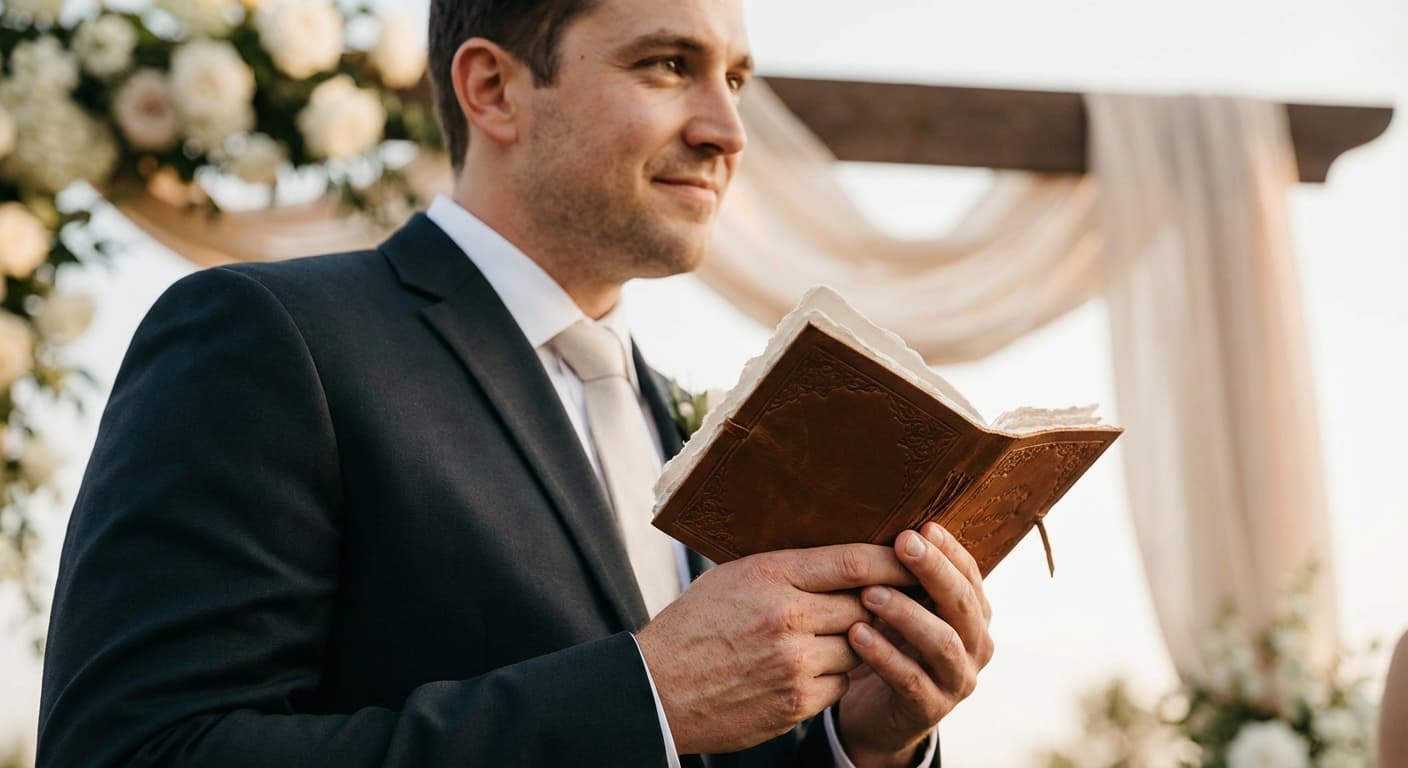
Wedding Vows for Him: Templates & Delivery Tips for Grooms
Wedding Vows for Him: Templates, Prompts & Delivery Tips for Grooms Who Struggle to Speak
Standing at the altar is a strange mix of calm and chaos. You are completely sure about the person standing across from you, but your brain suddenly forgets how to form a sentence. If you are dealing with writer’s block, hate being the center of attention, or feel a little allergic to public emotion, you are not alone. A lot of grooms love deeply but communicate quietly, and the pressure to perform feelings on demand can turn a beautiful moment into a source of genuine anxiety.
The good news is that vows do not have to sound poetic to be unforgettable. They have to sound like you. Short, specific, and real beats long, dramatic, and polished every time. You do not need to be a comedian or a professional speaker to deliver words that move hearts. You just need to be honest. If you are staring at a blank page, ToastPal can help you articulate your unique love story in minutes, acting as a digital best man who helps you find the right words when they feel out of reach.
This guide is built for the groom who struggles to speak. We will provide a simple structure to follow, short vow templates that work even if you are shy, fill-in-the-blank prompts that unlock what you already feel, and delivery tips that calm your body so your words can show up. We will also cover alternatives if you truly do not want to speak in public, without losing the meaning of the moment.
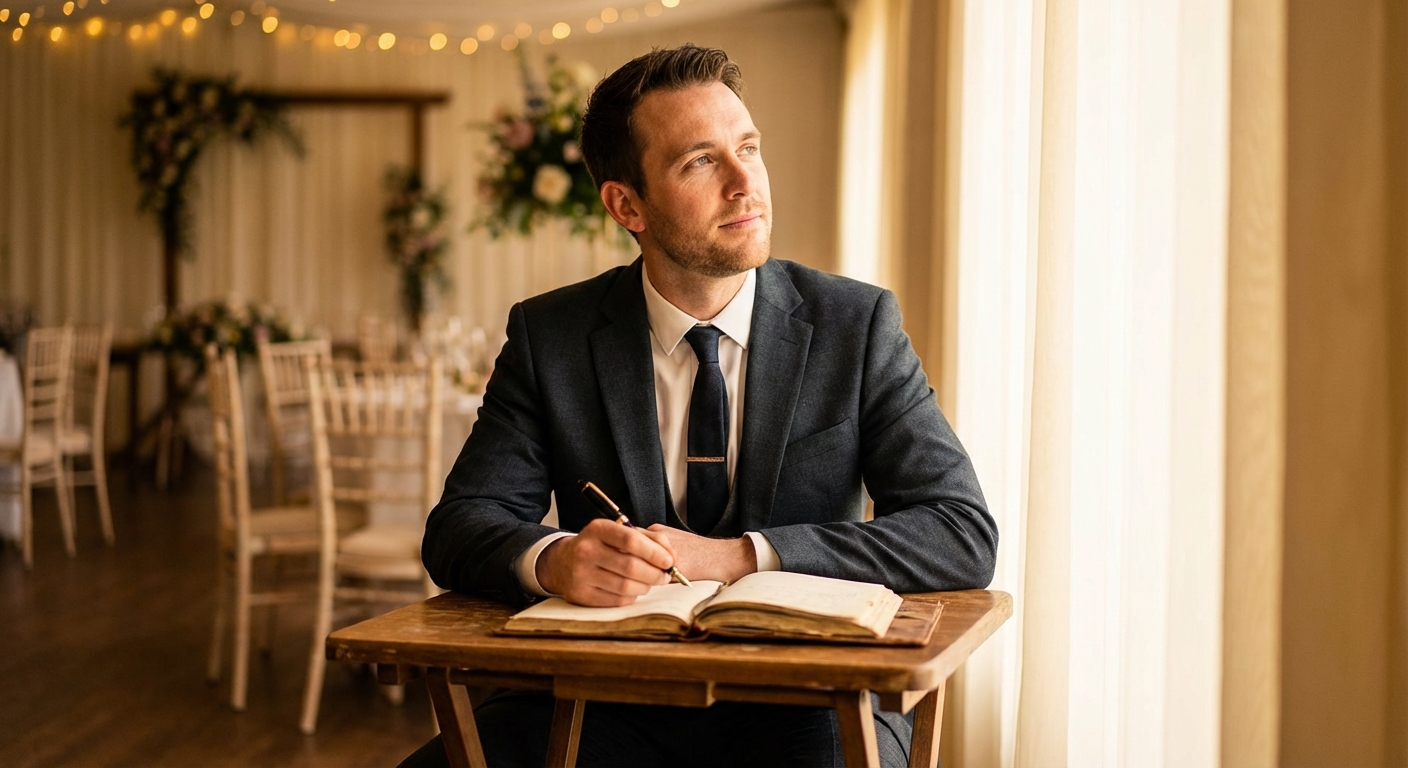
Why Personalized Vows Matter
It is tempting to grab something generic when you are stressed. The problem is not that traditional lines are bad, but that borrowed words can feel like borrowed clothes. They may technically fit, but they do not feel like you. Personalized vows act as the emotional anchor of the ceremony, creating a moment where the rest of the room fades away and it is just the two of you making promises that will define your marriage.
There is a very real cultural shift happening where modern couples increasingly want ceremonies that feel personal rather than performative. Research on marriage motivations from Pew Research consistently highlights love and companionship as the central reasons people choose to marry. That is why saying something personal matters more than sounding impressive. Your vows are the first promises you make as a married couple, setting the tone for how you will communicate, support, and cherish each other for decades to come.
When you write vows that include specific memories, inside jokes, and concrete promises tailored to your relationship, you prove you are paying attention. A promise like "I will always love you" is true, but it is hard to picture. A promise like "I will take your side, especially when life gets loud" is love you can imagine living. These words become a reference point for the marriage itself, especially in hard seasons when you need to remember what you chose and why you chose it.
A Simple 4-Part Vow Structure
If you are stuck on how to write wedding vows for him that do not feel cheesy, stop trying to write a speech. Instead, write four small pieces. This structure is simple, flexible, and especially good for reserved grooms because it keeps you focused and concise.
Aim for 60 to 120 seconds total. If you want to go even shorter, that is fine too. You are not graded on length; you are graded on sincerity.
Part 1: Who They Are to You (The Declaration)
Start by declaring what she means to you. This is one to three sentences that name who she is in your life, not just that you love her. Avoid broad clichés and get specific about her character.
Pick one of these starters and complete it in your own voice:
- "You are the person who makes me feel..."
- "With you, I feel..."
- "You are the calm in my life, and the spark that keeps it interesting."
- "You are my best friend, the one I want beside me in every version of life."
For shy grooms, keep it concrete. Instead of saying "You are amazing," try "You are steady," "You are brave," or "You are kind when it costs something."
Part 2: The Memory (The Story)
This is where your vows stop sounding generic. Choose one specific moment. Just one. You do not need your entire relationship timeline. Pick a memory that shows when you realized you were building a life, not just dating, or a funny mishap that now feels like "us."
Keep it short, two to five sentences.
- "I knew I wanted to marry you the night we got lost on that road trip and the GPS gave up. You started laughing, rolled down the windows, and turned it into an adventure."
- "I still remember the first time you met my family, and how you fit in instantly."
- "My favorite picture of us is that blurry one from our first hike, because it reminds me that the journey matters more than the destination."
Part 3: The Promises (The Action)
This is the heart of your vows. Keep it to 3 to 5 promises. Make them specific enough that you can actually live them. A strong set of promises usually includes one emotional promise (how you will show up), one practical promise (how you will help), and one growth promise (how you will keep choosing the relationship).
Examples of concrete promises:
- "I promise to listen first, not fix first."
- "I promise to speak to you with respect, especially when I am stressed."
- "I promise to make room for your dreams, even when they stretch us."
- "I promise to kill the spiders, handle the late-night errands, and never act like your needs are an inconvenience."
Part 4: The Closing (The Future)
End with a lifetime commitment that feels like you, not like a movie trailer. This closing ties everything together and gives your vows a sense of completion.
Closing templates:
- "I choose you today, and I will choose you every day."
- "I will spend my life loving you on purpose."
- "I take you as you are, and I commit to building a life with you."
- "No matter what comes, you will never face it alone."
30 Short Vows for Grooms Who Prefer to Keep It Brief
If you are shy, a 30 to 60-second vow can be perfect. Short wedding vows for him work because they reduce pressure, prevent rambling, and help you stay present. You are not less romantic for being concise; you are being clear. Below are options that are short but still personal sounding.
Romantic One-Liners
- You are my safest place, and I promise to be yours.
- I choose you, and I will keep choosing you.
- I promise to love you with patience, not just passion.
- You make my life feel like it finally makes sense.
- I promise to be steady for you, even when life is not.
- I promise to see you, not just look at you.
- I will protect our peace and fight for our joy.
- I promise to be honest, even when it is hard.
- You are my best friend, and I promise to treat you like it.
- I will love you in the ordinary days, not only the big ones.
Lighthearted & Funny Short Vows
- I promise to keep you laughing, even when I am the joke.
- I promise to share my fries, at least some of them.
- I promise to be your teammate, not your critic.
- I promise to handle the spiders and the weird noises at night.
- I promise to never stop dating you, even when we are busy.
- I promise to apologize faster and argue cleaner.
- I promise to learn your coffee order again if it changes, and not complain.
- I promise to be the calm one when you spiral, and let you be the calm one when I do.
- I promise to put my phone down when you are talking.
- I promise to love you like I love weekends: fully and with enthusiasm.
Traditional with a Twist
- I promise to love you faithfully and choose you intentionally.
- I promise to honor you, respect you, and protect our marriage.
- I promise to be present, not perfect.
- I promise to build a home with you that feels safe.
- I promise to support you, celebrate you, and stand with you.
- I promise to grow with you and not stop learning you.
- I promise to forgive quickly and keep my heart open.
- I promise to share my life with you, not just my time.
- I promise to love you in sickness and health, and in the in-between.
- I promise that as long as we both live, you will never be alone.
If you are looking for wedding vows for him examples that make you cry, the secret is rarely big drama. It is specificity. "You rubbed my back when I could not sleep" hits harder than "I love you forever."
Prompts for Stoic or Nervous Grooms
If you feel emotionally sincere but verbally clumsy, use prompts. Prompts help because they do not ask you to be creative; they ask you to remember. These vow prompts for shy grooms work especially well when you want to keep it short, avoid cringe, and still sound personal.
"I knew I wanted to marry you when..."
Finish this sentence with the exact moment everything clicked. Was it a specific date, a conversation, or a quiet realization during an ordinary day?
"I promise to encourage you when..."
Think about her dreams, her fears, her goals. When does she need your support most? Be specific about how you will show up for her.
"My life changed for the better because you..."
What has she brought into your life that was not there before? Laughter? Stability? A sense of purpose? Name it.
"You are the [adjective] to my [adjective]..."
Fill in the blanks with words that capture your dynamic. "You are the calm to my chaos" or "You are the adventure to my routine." Make it yours.
"The thing I love most about you is..."
Do not say "everything." Pick one specific quality that defines her in your eyes.
"I vow to always..."
This is your chance to make a concrete, actionable promise. What will you do, consistently, to make this marriage thrive?
If these prompts spark ideas but you are still struggling to turn them into flowing vows, ToastPal can take those raw notes and transform them into a polished draft that flows naturally while still sounding like you.
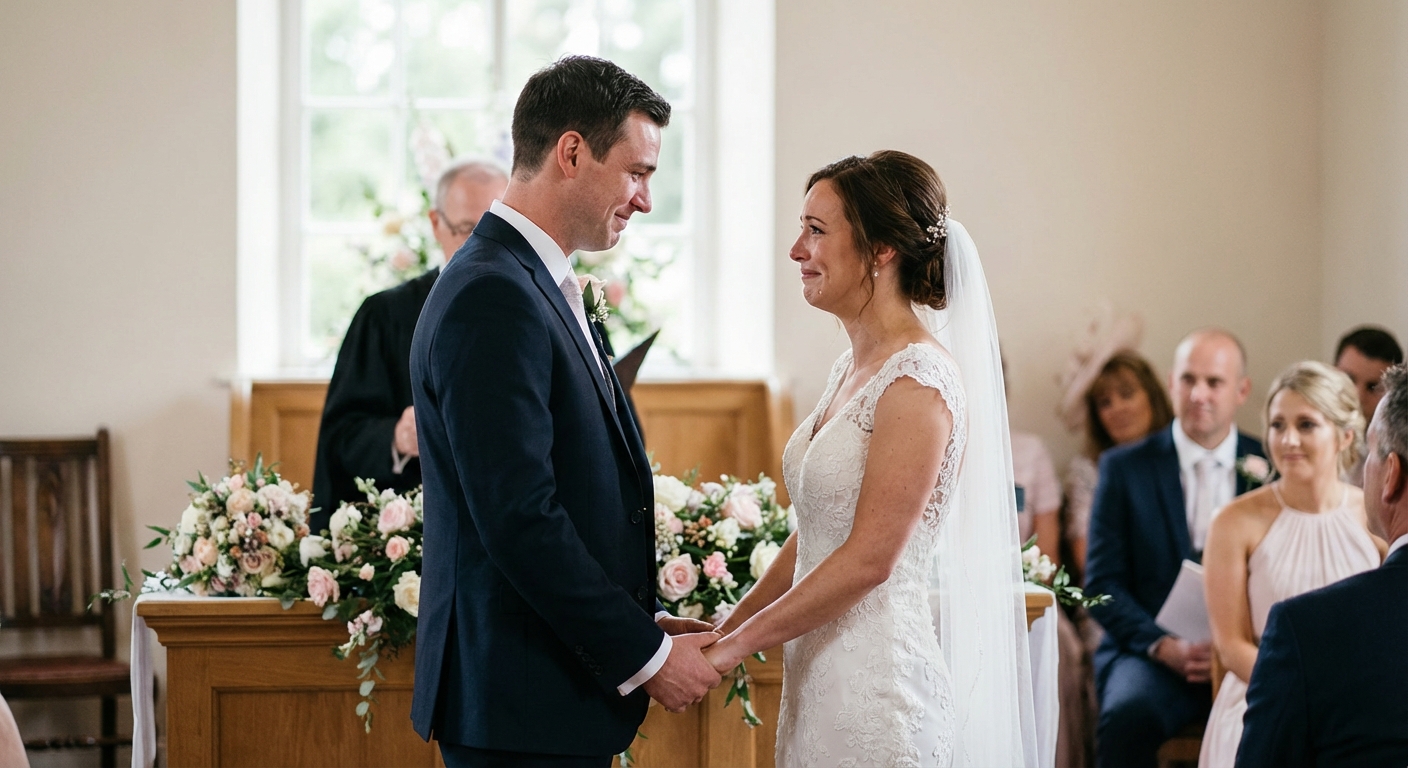
How to Deliver Your Vows Calmly
Writing your vows is half the work. Delivering them calmly is the other half, and this is where a lot of grooms spiral. Your hands shake, your throat tightens, and suddenly you are speaking at double speed just to escape the moment. You do not need to become a public speaker; you just need a plan.
The Power of Rehearsal
Rehearsal is not about memorizing. It is about making the words feel physically familiar in your mouth. Read your vows out loud, not in your head, once a day for five days before the wedding. Stand up when you practice. Practice at "ceremony volume," slightly louder than conversational. If you can tolerate one trusted person, read it once to a best friend or sibling and ask if it sounds like you.
Eye Contact and Anchoring
The room is not your audience. Your partner is. Pick one anchor: her eyes, the bridge of her nose if eye contact feels too intense, or her hands if you are holding them. Create an intimate bubble where it is just the two of you. When your brain blanks, look at your anchor, pause, and breathe. A pause reads as emotion and sincerity, not failure.
Reading vs. Memorizing
Do not memorize your vows. Memorizing adds pressure and increases the chance of blanking. Reading is not less romantic; it is responsible. Use small vow cards, a vow booklet, or a folded page with large font. Avoid using your phone if possible, as it can look casual in photos and notifications can ruin your focus.
A Breathing Reset
Right before you start, do this silently: Inhale through your nose for 4 seconds, hold for 2 seconds, and exhale slowly for 6 seconds. Longer exhales tell your nervous system that you are safe, allowing your body to calm down enough for your voice to steady.
The Trend of Vow Renewals
Remember that this is just the start. Many couples are now treating vows as something you return to, not something you perform once. The Gottman Institute notes that renewing vows can be a powerful relationship practice to reaffirm commitment. If the idea of big emotions in public is not your style, know that you can always refine and repeat your promises privately in the years to come.
Alternatives If You Don’t Want to Speak
Sometimes the issue is not nerves; it is that public vulnerability feels genuinely unbearable. If that is you, you still have options that honor the moment and protect your peace. These alternatives are valid and ensure the day remains joyful rather than terrifying.
The Private Vow Exchange
A private wedding vows template approach is often done during a "First Look" or in a quiet room before the ceremony. You still write vows and say them, but you do it without the crowd. You can then do traditional "repeat after me" lines publicly. This allows you to be deeply vulnerable without the stage fright.
The Letter Exchange
If speaking is too much, write your vows as a letter and read it privately the morning of the wedding, or exchange letters the night before. This gives you unlimited time to craft the perfect message without worrying about delivery. The letter also becomes a tangible keepsake you can frame or save.
The Officiant-Read Method
You write the vows, but the officiant reads them as questions during the ceremony. For example, the officiant asks, "Do you, [Name], promise to listen with patience and speak with respect?" and you simply answer, "I do." You still write the promises, and you still publicly commit, but you reduce the public speaking load significantly.
How ToastPal Helps: Personalized Vows, Practice Tools, and Keepsakes
If you are stuck, stressed, or worried you will sound awkward, you do not need more pressure. You need a process that makes this feel doable. ToastPal is built for moments exactly like this, when your feelings are real but the words are hard.
Effortless Crafting
Instead of staring at a blank page, you answer guided questions about your relationship: the memory, the tone, the promises you want to make, and the little details that make your relationship yours. A vow generator for grooms is only useful if it captures your specific voice, and ToastPal ensures the output is tailored to your unique story.
Tone Management
Whether you want to be funny, serious, or religious, the AI adjusts the tone perfectly. You can choose romantic, lighthearted, or traditional wording without feeling like you are borrowing someone else’s personality. This helps avoid the fear of sounding fake or overly dramatic.
Confidence Building
Having a polished, professional speech in hand reduces anxiety significantly. You know the words are strong, the structure works, and the sentiment is clear. That confidence translates into better delivery, allowing you to focus on your partner rather than your fear.
Keepsake-Friendly Output
Your vows are not just something you say once. A clean, well-written final version is easier to print into a vow book, save with photos, or revisit later for anniversaries. If you are ready to write vows that she will cherish forever, get started with ToastPal today and turn your writer's block into a moment you will be proud of.
FAQ
Q: How long should wedding vows for him be?
Ideally, vows should be 1 to 2 minutes long, which is roughly 150 to 200 words. This length is sufficient to be meaningful without losing the audience's attention. If you are shy, 30 to 60 seconds is perfectly acceptable as long as the content is sincere.
Q: Can I use a vow generator for grooms?
Yes, tools like ToastPal are excellent for providing a structure and a "first draft" that you can then tweak with personal details. The key is to use a tool that asks for specific memories and traits so the final result sounds like you, not a generic template.
Q: Is it okay to read my vows from a phone?
It is better to use a vow book or note cards. Phones can look casual in photos, and glare or notifications can be distracting. A physical copy looks more intentional and ensures you won't be interrupted by technology issues.
Q: What if I get too emotional to speak?
It is okay to pause. Take a breath, look at your partner, and smile. If you cannot finish, have the officiant step in or switch to "repeat after me" vows. Emotion is a good thing at a wedding; it shows the moment matters.
Q: How do I write vows if I'm not a writer?
Speak like you normally talk. Do not use formal language like "thee" or "thou" if that is not your style. Use a simple structure: who she is to you, one memory, 3 to 5 promises, and a closing commitment. ToastPal can help polish your natural language into a smooth draft.