Best Man Speech with an Interpreter: What to Cut for a Five-Minute Toast
Best Man Speech with an Interpreter: What to Cut for a Five-Minute Toast
You have five minutes, one excellent story about the groom, and an interpreter who needs time to tell it too. Suddenly, your carefully rehearsed four-minute speech is nowhere near short enough.
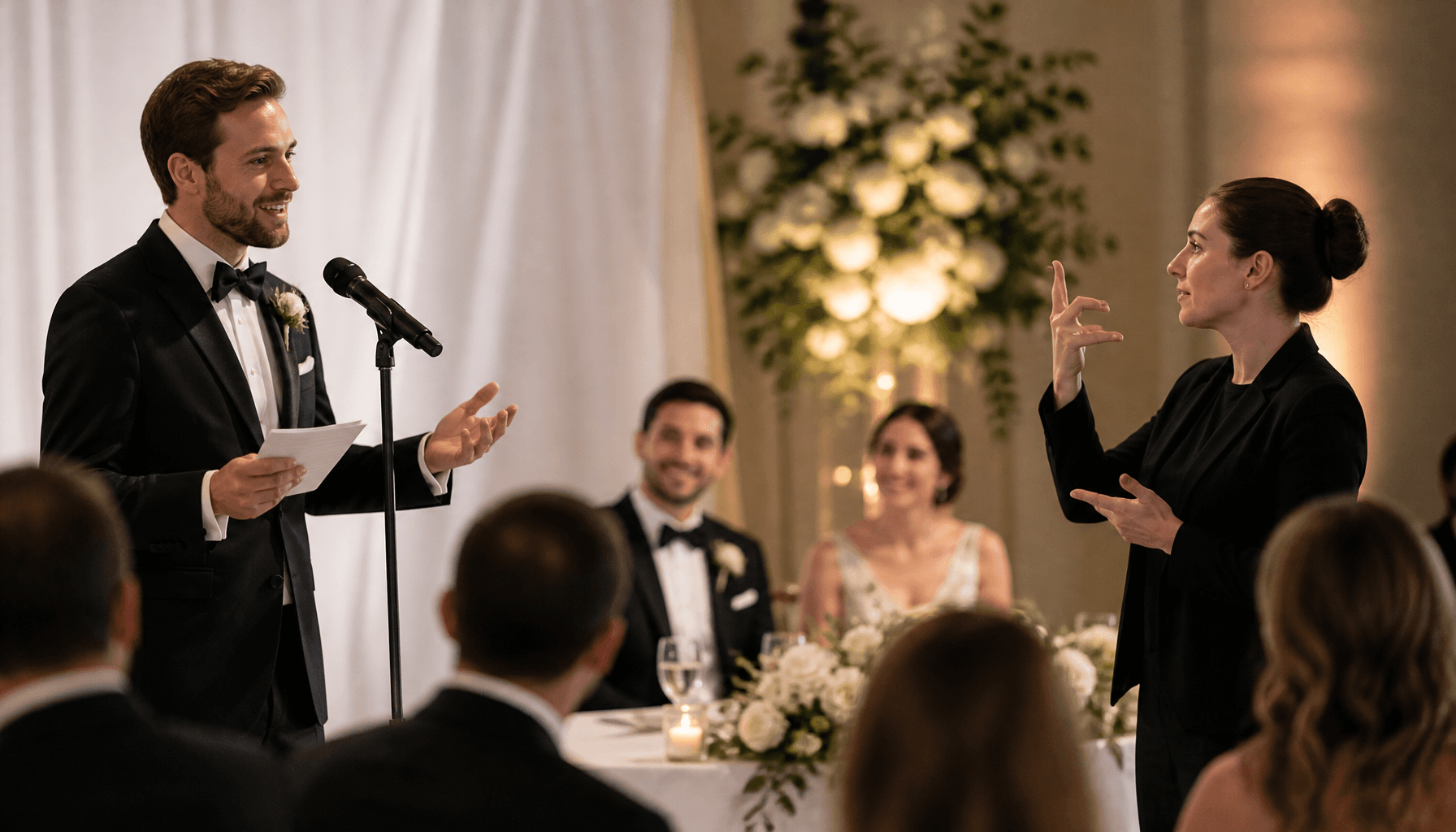
A best man speech with an interpreter needs a different edit—not simply faster delivery. If the interpreter translates after you pause, both voices count toward the reception slot. So do laughter, microphone handovers, and the final toast.
The solution is to protect the emotional core and cut everything that makes guests work to reach it. Here’s how to budget your five minutes, choose what goes, and give both language groups a speech worth hearing.
1. Budget for Two Voices Before You Write
First, confirm the format with the couple or wedding coordinator. Consecutive interpreting means you speak in short sections and the interpreter follows. Simultaneous interpreting happens while you speak, typically through dedicated equipment, so it needs a different timing plan. The advice below assumes consecutive interpreting.
Ask whether the five-minute limit includes your introduction by the host and the glass-raising moment. Then build a provisional budget:
- Your delivery: 1 minute 55 seconds.
- The interpreter’s delivery: 2 minutes 15 seconds.
- Laughter and audience reactions: 30 seconds.
- Handovers and raising glasses: 20 seconds.
That totals five minutes, but it is a planning example—not a universal translation ratio. Languages, delivery styles, and explanations of unfamiliar references can change the balance.
Start with roughly 220–250 words in your original-language script, then adjust after a joint rehearsal. At 120 words per minute, 230 words already take about 1 minute 55 seconds before interpretation. Don’t treat a standard five-minute best man speech word count as your allowance.
Your first rehearsal target should be closer to 4 minutes 30 seconds overall. A little unused time is better than the coordinator signaling you to stop before you have toasted the couple.
2. Cut Setup, Not Affection: Your Editing Order
When translation counts toward your five minutes, every unnecessary sentence costs time twice. Cut in this order so the speech gets smaller without becoming colder.
- Repeated welcomes and thank-yous. Unless you have been assigned formal acknowledgments, leave the catering credits and travel roll call to the hosts.
- Extra backstory. Guests need to understand your relationship, not reconstruct your friendship’s entire timeline.
- Second and third anecdotes. Keep one story that shows why the groom is a good friend or partner.
- Jokes requiring explanations. Puns, nicknames, and quotations from local television often need more context than the payoff deserves.
- Duplicate praise. If your story shows loyalty, you do not also need five adjectives describing it.
Before: “I first met Daniel in September 2011, during our second week at university, when we were both living on the third floor of a building that has thankfully since been demolished.”
After: “Daniel and I met at university. He has been looking after me ever since.”
That edit preserves the relationship and creates a route into the story. The building was scenery; the friendship is the point.
Before: “He’s generous, thoughtful, dependable, unbelievably kind, and always there when anyone needs anything.”
After: “When my car broke down at midnight, Daniel arrived with jumper cables and dinner.”
Keep the specific detail. It gives the interpreter something clear to convey and the guests something they can picture. Protect a direct acknowledgment of the groom’s partner, too: this is a wedding speech, not just a friendship tribute.
3. Write Short Speaking Blocks That Still Sound Like You
A translation-friendly wedding speech should not sound like a list of instructions. Use ordinary language, concrete images, and complete thoughts. Agree on manageable speaking blocks with your interpreter; one or two short sentences is a useful starting point.
Mark pauses at natural boundaries, not halfway through an idea. The interpreter needs enough context to convey the meaning, especially when a sentence sets up a joke.
Harder to interpret: “Daniel, who you’d think would have learned after the camping incident—which I promised not to mention—has somehow found someone willing to navigate life with him.”
Cleaner: “Daniel once took us camping without a tent. [Pause for interpretation.] Priya, I admire your confidence in his planning.”
Check that joke with both the couple and interpreter. Humor should feel affectionate in both languages, not imply that the marriage is a mistake.
Here is a short passage showing how warmth can survive the pauses:
“I’m Ben, Daniel’s best man and his friend since university. [Pause.]
“When my car broke down at midnight, Daniel brought jumper cables and dinner. He correctly guessed I had two problems. [Pause; allow laughter.]
“That’s what I admire about him: he notices what people need, then does something about it. [Pause.]
“Priya, when you saved him a plate at your own birthday party because he was running late, I recognized that same care. [Pause.]
“Please raise your glasses to Daniel and Priya. May you always look after each other in the little ways that matter.” [Pause for interpretation before drinking.]
Use this as a structural model, replacing the details with true memories. If choosing those memories is the sticking point, ToastPal’s best man speech tool can help you get a draft on the page before you make the timing cuts.
4. Rehearse the Whole Exchange, Not Just Your Half
Send the interpreter your script in advance, including names, pronunciation notes, relationships, and any cultural references. Explain the intention behind each joke rather than asking for a word-for-word rendering.
Then rehearse together with a stopwatch running continuously. Do not stop it during interpretation or pretend the audience will never laugh.
- Agree on a handover cue. A glance or small nod is less distracting than repeatedly saying, “Please translate.”
- Confirm microphone arrangements. If you must share one, practice passing it; handover time accumulates.
- Wait for both audiences. One group may laugh before the other understands the joke. Don’t begin the next line over the interpretation or second reaction.
- Mark one optional cut. Choose a sentence that can disappear without breaking the story, and tell the interpreter in advance.
If the rehearsal runs long, delete material rather than racing. After your last edit, send a clearly labeled final script so the interpreter is not preparing from an outdated version. On the day, resist spontaneous additions—even a quick extra anecdote needs its own translation time.
5. Finish with One Clear Toast
The best five-minute interpreted best man speech is not a longer speech squeezed into gaps. It is one strong story, a genuine acknowledgment of both partners, and a clear wish for their marriage—with room for everyone to hear it.
Budget for both voices, cut background before affection, and rehearse the full exchange. Then let the interpreter finish your final toast before you drink. Both sides of the room should get to celebrate the same ending together.