Last-Minute Stand-In Best Man Speech: What to Ask the Groom Before You Take the Mic
Last-Minute Stand-In Best Man Speech: What to Ask the Groom Before You Take the Mic
The groom catches you beside the seating plan: “Could you do the best man speech?” The original speaker is unavailable, dinner is nearly finished, and you have nothing written beyond a congratulatory text.
A last-minute stand-in best man speech does not need a lifetime of shared adventures or a spectacular punchline. It needs accurate details, one warm observation, and a clear toast. Your job is to celebrate the couple—not impersonate the person who was supposed to speak.
Before you start drafting, borrow three minutes with the groom. The questions below will help you find something genuine to say, avoid awkward surprises, and build a short wedding speech you can deliver with confidence.
1. Ask the Groom These Five Questions First
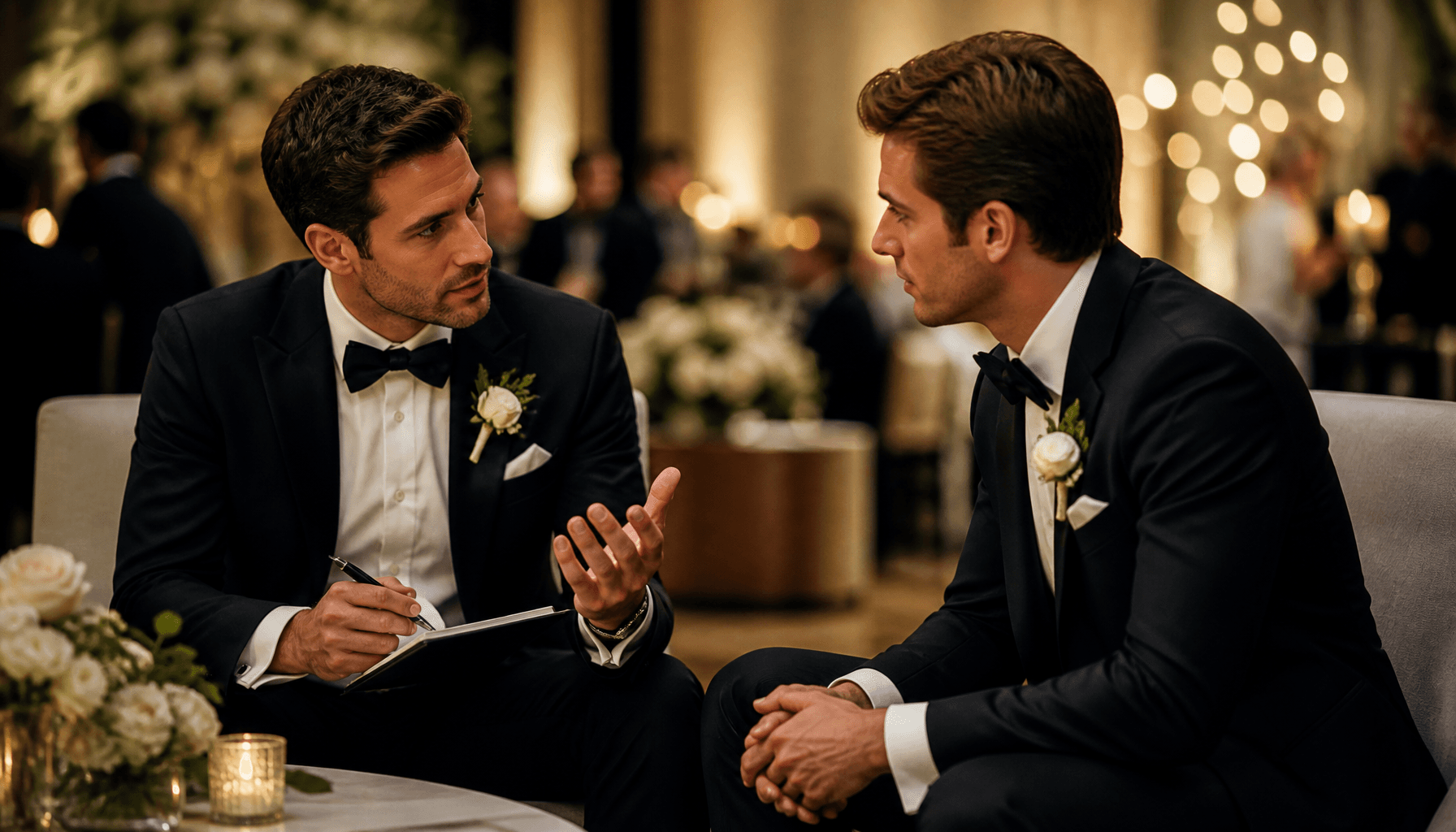
Open with a practical promise: “I’ll keep this short and warm. I just need a few details so I get it right.” Then ask these questions in order. If someone interrupts, you will already have the essentials.
- “How should I introduce myself, and should I mention the change of speaker?” Being asked to give the toast does not necessarily make you the replacement best man. Confirm your role rather than awarding yourself a title.
- “How do you want me to refer to your partner?” Confirm their name, pronunciation, and preferred wording. Do not debut an unfamiliar nickname or assume either person has changed their surname.
- “Is there anything I absolutely should not mention?” Specifically flag previous relationships, private family matters, embarrassing stories, and the reason the original best man is absent.
- “Is there anyone I need to acknowledge?” Ask whether the original best man should be named and whether any essential thanks are yours to deliver. Avoid duplicating a planned tribute.
- “How long have I got, and who is speaking before and after me?” Get an initial answer, then confirm the running order with the MC or coordinator.
Do not make the groom explain a sensitive absence. Ask for the approved wording instead. If he says, “Please don’t mention it,” that settles the question.
Instead of: “The real best man couldn’t make it, so you’re stuck with me.”
Try: “For anyone I haven’t met, I’m Daniel, a friend of Alex’s, and I’m delighted to offer a toast to these two.”
The second version introduces you without making the absent speaker—or your own nerves—the subject of the celebration.
2. Get One Specific Story and One Detail About the Couple
Once the boundaries are clear, collect material. “Tell me something funny” often produces a blank stare. Small, concrete prompts work better:
- “What is one little thing your partner does that you love?” Look for everyday details: leaving encouraging notes, remembering everyone’s coffee order, or making an ordinary Tuesday feel special.
- “When did you realize you worked well as a team?” A cancelled train or a disastrous flat-pack bookshelf can reveal more than a grand romantic claim.
- “What is one thing you admire about your partner?” Follow up with “What’s an example?” to turn “They’re thoughtful” into usable material.
Write down the groom’s actual language. “They make ordinary days feel like something worth celebrating” has more personality than “They are my soulmate and greatest inspiration.” You can polish the grammar without replacing his voice.
Then add one observation of your own. Perhaps the groom checked that every guest had a lift, or his partner made you feel welcome immediately. A modest truth is stronger than an invented history.
Instead of: “I’ve watched their incredible love story from the beginning.”
Try: “I haven’t known Morgan as long as some of you, but every time we’ve met, they’ve made me feel part of the group.”
If you use a story you did not witness, attribute it: “Alex told me…” That keeps your stand-in best man speech honest and gives the groom’s words their proper weight.
3. Build a Short Best Man Speech Around Four Beats
Unless the couple requests otherwise, aim for roughly two minutes. Around 220–260 words gives you room for pauses, but time a read-through rather than trusting the word count alone.
Use four beats: introduce yourself, share one detail, celebrate the partnership, invite the toast. Skip the long thank-you list and any joke that needs a complicated setup.
Here is a compact example using fictional details. Replace every factual claim with something you know or have confirmed:
“Good evening, everyone. I’m Daniel, Alex’s friend from university, and I’m very happy to raise a glass to Alex and Morgan.
“One thing I’ve always appreciated about Alex is that he shows up. When I moved house, he arrived early, carried the heaviest boxes, and stayed until we found the kettle.
“Today, I asked him what he loves about life with Morgan. He said, ‘Even a trip to the supermarket feels like time together.’ I thought that was a lovely answer. Not especially useful if you’re trying to finish the shopping quickly, but lovely.
“I haven’t known Morgan as long, but I’ve seen how easily they make people feel welcome. Together, these two seem to find something worth enjoying in the ordinary parts of life.
“My wish for you is plenty more of that: good company, small adventures, and someone beside you when the boxes need carrying.
“Please raise your glasses to Alex and Morgan. To a very happy marriage.”
If the opening still will not come, ToastPal’s best man speech writer can help turn your notes into a draft. Check every anecdote and relationship detail before using it; polished wording is not a substitute for accuracy.
4. Confirm the Handoff and Rehearse the Last Line
Once the speech is written, stop asking the groom for more material. Your remaining preparation is logistical.
- Check with the MC: Confirm your introduction, speaking position, time limit, and whether your toast ends the speeches. Ask how the microphone will reach you.
- Prepare readable notes: Use large text and short paragraphs. On a phone, enable Do Not Disturb and keep the speech available offline.
- Read aloud once: Cut sentences that make you stumble. Mark a pause after the introduction and before the toast.
- Check the final cue: Make sure guests have drinks before inviting them to raise a glass. They do not need alcohol to join in.
Memorize the opening sentence and closing toast, not the entire speech. Those two anchors make it easier to begin calmly and finish cleanly. If a joke gets no laugh, continue without commenting on it. If you lose your place, return to the couple: “What matters most is how happy we all are to celebrate you today.”
5. Take the Mic With a Clear, Honest Toast
A successful last-minute stand-in best man speech starts with a few careful questions: how to introduce yourself, what to leave out, and which genuine detail captures the couple. Build around that detail, confirm the handoff, and rehearse aloud. You do not need to prove you were the perfect original choice. You just need to give the couple a warm moment worth remembering.