Father of the Groom Speech: Funny Marriage Advice and Heartfelt Promises
The laugh is easy to imagine. You offer your son a piece of marriage advice, the room chuckles, and you feel your shoulders relax. But what comes next matters more: a few words that tell the newlyweds you’re not just here to tease them—you’re here for them.
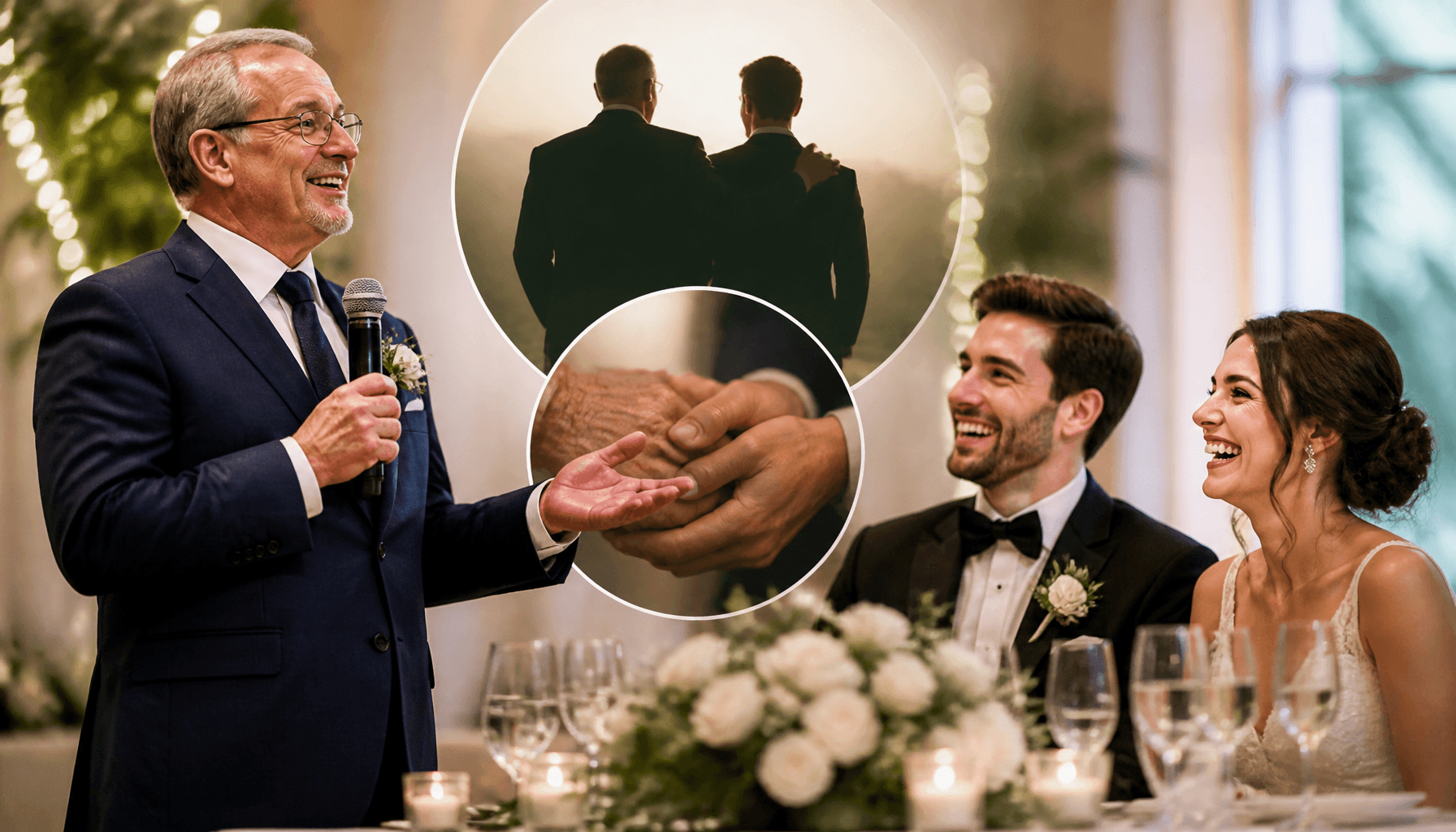
A memorable father of the groom speech pairs gentle humor with sincere promises of support. The joke opens the door; the promise gives it meaning. Here’s how to build that balance into a wedding speech that sounds like a father talking to people he loves, rather than someone performing a borrowed comedy routine.
1. Build Your Father of the Groom Speech Around One Message
Before collecting jokes or childhood stories, finish this sentence: “What I most want these two to know is…” A useful answer might be, “I trust the life you’re building, and you can count on me.” That becomes your filter: keep material that reinforces it, and cut anything that competes with it.
For a speech of roughly four minutes, aim for about 450–550 words, then time yourself aloud. Laughter, pauses, and emotion all take longer than silent reading suggests. Confirm your allotted time with the couple rather than assuming there’s room for a long tribute.
- Introduce yourself briefly and welcome guests.
- Share one story that shows something you admire about your son.
- Address his spouse directly with a specific observation or welcome.
- Offer one or two funny pieces of advice, each followed by a genuine promise.
- Finish with a short wedding toast to both newlyweds.
Choose a story with a useful landing. Your son patiently teaching a younger cousin to ride a bike can lead into kindness and teamwork. An account of his worst teenage mistake probably needs more explanation—and permission—than it’s worth.
2. Pair Each Marriage Joke With a Promise of Support
The strongest funny marriage advice doesn’t make marriage sound miserable. It recognizes ordinary friction while showing confidence in the couple. Let your own habits be the punchline, not either newlywed’s character.
Use this pattern: everyday observation, gentle laugh, meaningful promise. You don’t need to announce the transition with “But seriously.” A pause and direct eye contact will usually do the work.
For a practical, understated father
“My marriage advice is to measure the doorway before buying the sofa. Love is powerful, but it doesn’t bend a hardwood frame. And when you need an extra pair of hands—moving furniture or figuring out a difficult week—I’m a phone call away.”
This works because the support grows naturally from the joke. Only promise moving-day help if you can realistically provide it; otherwise, offer dinner or company while they unpack.
For a dad who tends to offer solutions
“I’ve learned that ‘Would you like me to listen or help?’ is a much better opening than ‘Here’s what you should do.’ I’m still practicing. My promise to you both is that I’ll ask before launching into a plan.”
The humor comes from self-awareness, and the promise establishes a healthy boundary.
Replace a tired joke with something warmer
Before: “Marriage is when you learn your wife is always right.”
After: “You won’t agree on everything. I’m still convinced the dishwasher has a correct loading pattern. But I promise not to referee your disagreements—or inspect your kitchen.”
The revised version avoids gender stereotypes and makes your own certainty the joke. Pick the example closest to your personality; using all three could make the speech feel like a list.
3. Make Your Promises Specific, Inclusive, and Realistic
“We’ll always be here” is affectionate, but a concrete promise helps the couple picture what that means. Offer something within your control—not unlimited money, constant availability, or a future role they haven’t asked you to take.
- Instead of “We’ll fix anything,” try: “When something goes wrong, you won’t have to pretend everything is fine before calling me.”
- Instead of “I’ll keep him in line,” try: “I’ll respect that you make your decisions together.”
- Instead of “We can’t wait to babysit,” try: “Whatever shape your future takes, I look forward to being part of it in ways that help.”
Address your son’s spouse as a person, not as his new caretaker. Replace “Thank you for putting up with him” with an observation: “Sam, I admire how you make room for the quietest person at the table.” Choose something you have actually witnessed.
Speak only for people who have agreed to the promise. If you’re speaking for yourself, “I” is warmer and more accurate than a sweeping “our whole family.” In complicated family circumstances, there’s no need to explain the history publicly.
You also don’t need a perfect marriage history to offer useful advice. “One thing I’ve learned” leaves room for humility in a way that “The secret to a successful marriage” doesn’t.
4. Turn the Ideas Into a Speech You Can Say Naturally
This short father of the groom speech example shows the sequence in action. Treat it as a framework, replacing the names, memories, and offers with your own.
“Good evening. I’m Michael, Daniel’s dad. Thank you for being here to celebrate Daniel and Sam.
“When Daniel was twelve, he helped his little cousin learn to ride a bike. He ran alongside her until she shouted, ‘You can let go now!’ He looked more nervous than she did. What stayed with me wasn’t the cycling. It was his determination that she should feel safe.
“Sam, I’ve noticed that same care in the way you two treat each other. And I admire how you welcome people—not just with an invitation, but by remembering what matters to them.
“My practical marriage advice is to measure the doorway before buying the sofa. I offer that as a man who once had to remove a door.
“And my promise is this: when you need help, you can ask. I’ll listen before advising, respect the decisions you make together, and bring dinner when cooking is the last thing you need.
“Daniel, being your dad has been a joy. Sam, getting to know you has been another. Please raise a glass to Daniel and Sam—to laughter at home, patience on difficult days, and a life you’re glad to share.”
If the transitions are where you get stuck, ToastPal can help you shape your memories and promises into a father of the groom speech you can revise in your own voice.
Rehearse standing up. Pause after the joke without waiting indefinitely for a laugh; then slow down for the promise. Print your notes in large type, with paragraph breaks before emotional lines. If your voice catches, take a breath rather than apologizing.
5. Close With Affection, Not Another Punchline
Your father of the groom speech doesn’t need to prove that you’re the funniest person in the family. Give the room one recognizable story, a little gentle marriage advice, and a promise the couple can believe. Then let the final toast belong to them. The laughter makes the moment enjoyable; your steady, specific support is what gives it lasting weight.