Mother of the Bride Speech: Honor Her Late Father While Celebrating the Couple
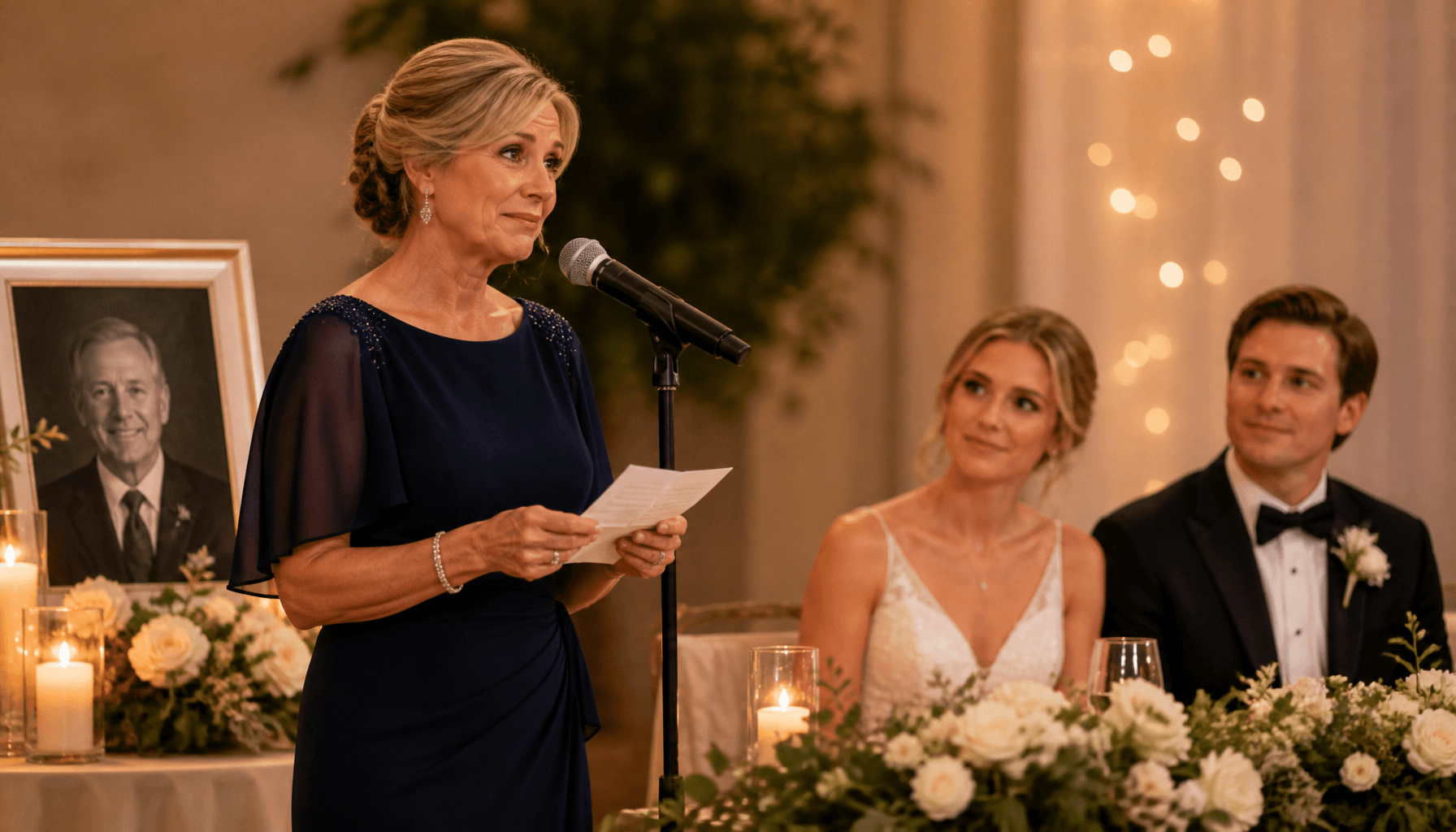
You may know exactly what your daughter’s father would have loved about her wedding: the song she chose, the expression on her face, or the person standing beside her. Finding a way to say that aloud is harder. You want to acknowledge his absence without making your daughter’s wedding speech feel like a farewell.
A mother of the bride speech honoring her late father can hold both feelings: missing someone deeply and celebrating wholeheartedly. The key is to give his memory a meaningful place, then connect that memory to your daughter, her partner, and their future. Here’s how to make that balance feel natural rather than carefully managed.
1. Agree on the Tribute Before You Write It
Before drafting, ask your daughter how she wants her father acknowledged. A reception microphone is not the place to surprise her with a recording, a deeply personal story, or an invitation for everyone to stand in remembrance.
Try a specific, low-pressure question: “I’d love to include a few sentences about Dad and the kindness you share with him. Would that feel right, or would you prefer a simple mention?” This gives her something concrete to respond to without asking her to write your speech.
- Ask whether there is a memory she would welcome—or one she would rather keep private.
- Check whether the ceremony or another speaker already includes a tribute, so your speech adds something rather than repeats it.
- Confirm whether she is comfortable with spiritual language. “He’s watching over us” may comfort one person and feel wrong to another.
You do not have to explain the circumstances of his death. Guests need enough context to understand your words, not the family’s grief history. If your relationship with him was complicated, center what is true about his connection with your daughter; you do not need to rewrite your own.
2. Build a Couple-First Mother of the Bride Speech Structure
Start with an outline that makes the wedding—not the loss—the organizing principle. For a four-minute speech, roughly 450–550 words is a useful drafting range, allowing for pauses and emotion. A remembrance of two to four sentences often gives the tribute enough space without becoming a separate memorial speech.
Use this sequence as a starting point, not a rigid formula:
- Welcome the room and name both newlyweds.
- Share one revealing story about your daughter.
- Connect a quality in that story to her father’s memory.
- Show how her partner complements or shares that quality, using something you have witnessed.
- Finish with a wish and a toast to their marriage.
The transition matters more than hitting a precise word count. Instead of placing a tribute in the middle and abruptly saying “Anyway, back to the wedding,” let a shared value carry you forward.
For example: “Her dad had a gift for making people feel included, and I see that same instinct in Maya. When she and Alex hosted their first family dinner, nobody was allowed to hover awkwardly in the kitchen—including me.”
That movement gives his memory a living connection to the couple. It also creates a natural opening for a story about both of them.
3. Choose Specific Memories Over Heavy Declarations
A small, recognizable detail usually carries more warmth than a sweeping statement about loss. Think of something your daughter would instantly recognize: his terrible directions, his handwritten birthday cards, or the way he always saved her the corner piece of cake.
Choose a detail that belongs comfortably in a wedding speech. Avoid private final conversations unless your daughter has explicitly welcomed their inclusion.
Before and after: wording that leaves room for joy
- Instead of: “This day will never be complete without your father.” Try: “We miss your dad today, and it means so much to celebrate the daughter he loved.”
- Instead of: “Your father would want you to stop crying and be happy.” Try: “There’s room today for missing him and for every bit of this happiness.”
- Instead of: “Alex, you’re the man of the family now.” Try: “Alex, I’m grateful for the thoughtful, steady partnership you and Maya have built.”
The first versions can unintentionally label the wedding incomplete, prescribe your daughter’s feelings, or assign her partner a replacement role. The alternatives acknowledge the loss without placing a responsibility on either newlywed.
If her father never met her partner, avoid claiming certainty about what he would have thought. Ground the connection in something you know: “Her dad valued people who kept their word. I’ve watched Alex do that in a hundred quiet ways.”
For humor, choose affectionate recognition rather than a joke about death: “He would have checked the weather six times before this outdoor ceremony. Maya checked it seven.” Use it only if that sounds like your family.
4. Adapt a Sample, Then Rehearse the Emotional Turn
This short mother of the bride speech example shows how remembrance can flow into a celebration of the relationship. Replace the names and details with true observations; expand the couple’s story if you have more speaking time.
“Good evening, everyone. I’m Helen, Maya’s mum. Thank you for being here to celebrate Maya and Alex.
“When Maya was little, she set an extra place at every birthday tea because, she said, someone else might come. She has always believed there’s room for one more.
“Her dad shared that instinct. He could turn a five-minute conversation with a neighbor into an invitation to dinner. We miss him very much today, and I love seeing that generous part of him in our daughter.
“Then Alex came along, and suddenly there were two people insisting I stay for supper. What reassures me isn’t simply that Alex loves Maya. It’s how they care for each other. When Maya started her new job, Alex practiced her commute with her. When Alex was studying late, Maya left dinner and a ridiculous encouraging note outside the door.
“You two understand that a good life is made in those ordinary moments. My wish is that you keep noticing what the other person needs—and keep making room at your table.
“Please raise your glasses to Maya and Alex: to a home full of welcome, laughter, and love.”
Make the speech easy to deliver
Rehearse aloud, especially the sentence immediately after the remembrance. Mark a pause there and put the next couple-focused sentence on a new line in your notes. That gives you an obvious place to resume if you become emotional.
If you need a moment, stop and breathe. You do not owe the room an apology for tears. You can also prepare a shorter tribute sentence to use if the longer passage feels too difficult on the day.
If your memories are clear but the wording keeps stalling, ToastPal’s mother of the bride speech tool can help you turn those details into a draft you can revise in your own voice.
5. Close on the Marriage They Are Beginning
You do not need to measure a father’s importance by the length of his tribute. Agree on the acknowledgment with your daughter, choose one truthful memory, and use it to illuminate something wonderful about the couple. Then let your final words belong to their future. A heartfelt toast can honor who is missing while warmly celebrating the two people everyone has gathered to support.